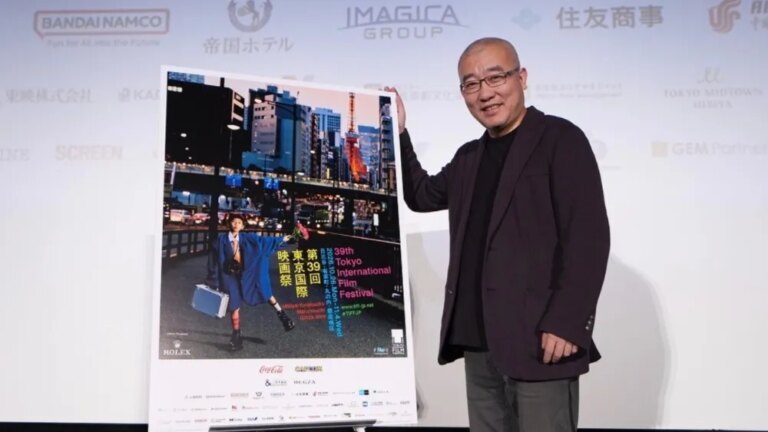
Chinese artist and filmmaker Sun Xun has achieved a remarkable milestone with his latest work, “Magic Atlas,” becoming the first animated feature to be selected for the competition at the prestigious Tokyo International Film Festival (TIFF).
Bridging Art Forms
Sun never regarded “Magic Atlas” solely as an animated film. Instead, he views it as a convergence of various art forms, explaining, “Animation is simply the label we use for its form. I’m glad people at TIFF understood the effort I put into it,” he told Variety.
A Decade in the Making
The film, which took a decade to create, is set in Luocha, a coal-mining empire where flight is prohibited. Every sixty years, the people forget the past due to a festival. After a magician is imprisoned, he encounters an orphan boy and gives him the Magic Atlas, a book that unveils the erased history of their empire.
Visual Storytelling
Notably, “Magic Atlas” employs a range of artistic techniques, including woodblock prints, ink painting, and vibrant colors. The film’s imagery often conveys meaning without relying on a conventional narrative structure, drawing inspiration from diverse art and visual traditions across cultures and historical periods.
Personal and Global Influences
Sun’s creative journey was deeply influenced by global events such as the pandemic and the war in Ukraine, along with personal transformations like his conversion to Buddhism. He invested all his savings into the project, navigating financial challenges when art sales dwindled during the pandemic. “In my own artistic thinking, I believe every creator should have one ‘all-in’ moment in their life,” he stated. For him, “Magic Atlas” represented that moment, as he aimed to complete it before his child matured and while his parents were still alive—a poignant aspiration underscored by the loss of his father just a year before the film’s completion.
A Universal Reflection
Rather than address specific events, Sun has chosen to encapsulate various cultural and political influences to reflect on the ongoing divisions in the world. He incorporates visual elements from ancient civilizations, including pyramids, alongside mythological motifs. “Film cannot address reality directly, but it can take a wider view. It can express how we understand the world and what we are curious about,” he remarked.
Artistry Over Commercialism
When asked about the necessity of clear storytelling in films, Sun expressed his discontent with a narrative-driven approach often used for commercialization, stating, “I object to films that emphasize story for the sake of packaging and commercial purposes. As an art form, film should express a state of being.” He cited the works of filmmakers Andrei Tarkovsky and Béla Tarr as inspirations due to their authentic engagement with existence beyond imagined narratives.
Challenging Perspectives
While crafting “Magic Atlas,” Sun immersed himself in the study of Dunhuang murals, Song dynasty paintings, calligraphy, and imagery from various cultures. Concerning the film’s complexity, he acknowledged, “There will always be a barrier to entry. Ten years of work naturally gives the film depth. But I made this important work for myself. My goal was to realize it, not to please every viewer.”
Future Endeavors
Plans for exhibitions related to “Magic Atlas” are underway in the U.S. and Singapore, although specific venues and dates have yet to be announced. Furthermore, Sun has commenced a new project, “All or Nothing,” known in Mandarin as “Fuyou,” or “Mayfly.” This upcoming film will delve into the personal experience of memory loss, continuing the exploration of themes introduced in “Magic Atlas.” The first shot was filmed at an exhibition space in Hangzhou, with aspirations to complete the feature within the next two years.