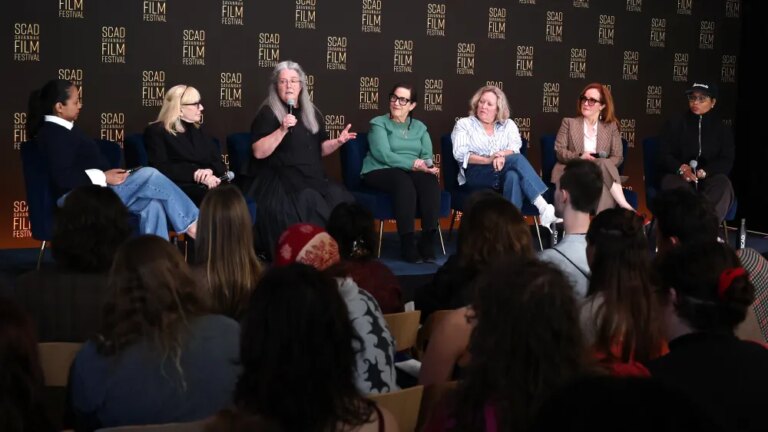
Costume design in contemporary filmmaking is often simplified to mere shopping, but experts in the field emphasize the depth of storytelling behind every choice in character attire. At the recent Costume Design Roundtable during the SCAD Savannah Film Festival, a group of prominent costume designers explored the complexities and nuances involved in contemporary costume design, shedding light on a profession that demands both creativity and a profound understanding of character.
Understanding the Roots of Costume Design
Molly Rogers, who served as an assistant costume designer on “The Devil Wears Prada” and later designed its sequel, expressed her concerns about misguided perceptions within the industry. “When someone comes up to me and says, ‘I really want to learn and work with you. I love to shop.’ That’s an automatic exit,” she noted, highlighting how such an attitude dismisses the intricate work involved in designing costumes that resonate with a character’s journey.
The Challenges of Contemporary Design
At the roundtable, moderated by Variety’s Senior Artisans Editor Jazz Tangcay, Rogers was joined by fellow costume designers including Ellen Mirojnick, Arianne Phillips, Linda Muir, Amy Roth, and Marci Rodgers. Mirojnick, renowned for her iconic pieces in films like “Wall Street” and “Basic Instinct,” reflected on her journey. “In the beginning of my career, I did a lot of contemporary costume, and I loved it. I loved being able to document what New York was like at that period,” she explained, recognizing that creating contemporary costumes is both challenging and aesthetically rewarding.
Character-Driven Choices
Rogers recalled her debut as a costume designer on Spike Lee’s “She’s Gotta Have It,” where she immersed herself in the local fashion to shape the character of Nola Darling. “Purple is clearly going to be a thing. But it would be tidbits of purple. She wouldn’t shop at Saks,” Rogers shared, indicating a preference for thrift stores to authentically capture Nola’s essence. On “Barbershop,” she emphasized mirroring the community’s style, acknowledging the unpredictable nature of contemporary design. “A professor cautioned me that contemporary design would be the hardest thing I’d ever do,” Rogers admitted.
A Balancing Act of Storytelling and Commerce
Phillips elucidated the misunderstandings surrounding contemporary costume design, particularly when working with high-profile executives in the industry. “I’ve been in rooms with studio executives…they can afford what they want, and they’re experts,” she said, pointing out how that often leads to misconceptions about costume designers’ roles. “You have to be a salesperson for your character,” Phillips remarked, stressing the need for genuine collaboration to support the artistic vision.
Amidst increasing product placement requirements in filmmaking, Phillips pointed out the growing complexities surrounding character wardrobe choices, noting, “We’re told by producers, ‘You have to use that product.’” As creative professionals, designers must navigate artistic integrity while adhering to commercial demands.
Recent Projects and Insights
The designers shared insights into their recent works, highlighting the intricacies of their craft. Mirojnick, for instance, meticulously created over 5,300 costumes for Christopher Nolan’s film featuring Anne Hathaway as Queen Penelope, ensuring her outfits remained aligned with the narrative. “It was very important to keep her in those tones, not to disrupt the story,” she asserted.
Rogers reflected on her work in “The Devil Wears Prada 2,” acknowledging the weight of expectations from its predecessor. Balancing nostalgia and newness, she brought back the beloved cerulean sweater, creatively reimagined as a vest through a character-driven transformation. “I wanted to shred it more naturally…but she chopped the sleeves off,” Rogers explained.
Amy Roth discussed her role in recreating the iconic look from “Rocky” for “I Play Rocky,” where her challenge was compounded by the absence of a costume designer in the original film. “Recreating this iconic look — not just from the film, but from my memory…the hat, the leather jacket, the gloves…they were all crucial,” she stated, conveying the pressure to deliver a faithful homage.
Concluding Thoughts on Costume Design
The conversation at the roundtable underscored that costume design in contemporary film extends beyond mere aesthetics. It is an art form that requires deep thought, historical context, and a commitment to character development. As the boundaries between commerce and creativity continue to blur, the role of costume designers remains pivotal in crafting the narratives that captivate audiences on screen.
Watch the full conversation below.