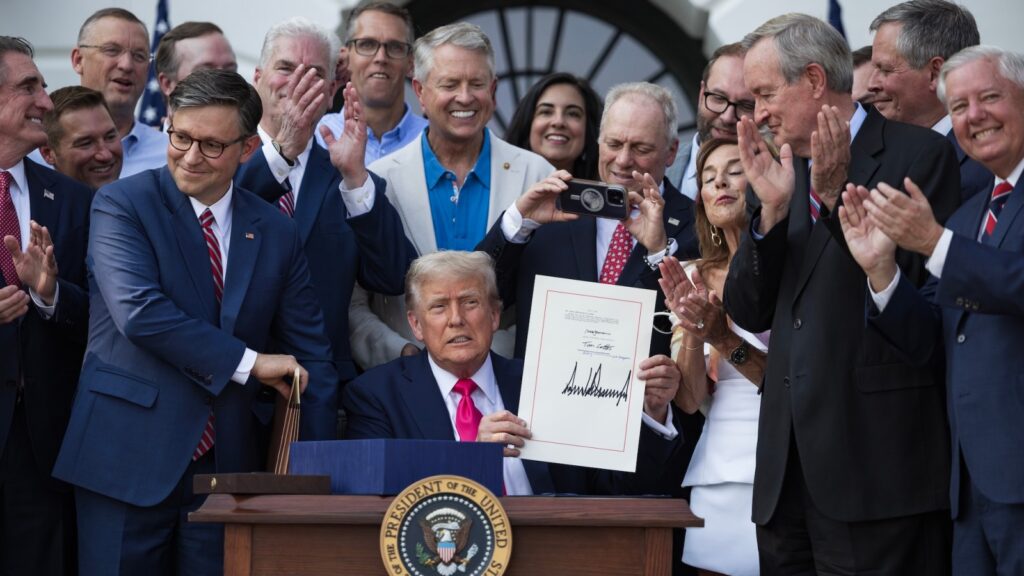
In a recent development highlighting political discontent, a new Wall Street Journal poll reveals that Donald Trump‘s “One Big Beautiful Bill” has failed to win over American voters. This landmark legislation, which plays a crucial role in shaping financial and social policies, seems to be causing more concern than approval among the electorate.
Widespread Opposition to Trump’s Bill
The central elements of Trump’s “One Big Beautiful Bill” include significant tax cuts for the wealthy, a reduction in Medicaid funding by $1 trillion, increased immigration enforcement spending, and substantial support for the fossil fuel industry. These measures, yet to be fully implemented, are facing widespread public backlash. The poll indicates that more than half of the 1,500 registered voters surveyed—52 percent—oppose the bill, while only 42 percent are in favor.
The divide is particularly pronounced among political affiliations. An overwhelming 94 percent of Democrats and 54 percent of independents are against the legislation. In contrast, only 12 percent of Republicans express opposition. A dominant 70 percent of respondents believe the bill favors the wealthy, with a substantial portion concerned about adverse effects on the poor, working class, Social Security recipients, the economy, the federal deficit, and beneficiaries of Medicaid and nutrition programs.
Reactions and Criticisms
The bill’s unpopularity has prompted criticisms from various quarters. “Cutting Medicaid is unpopular. Cutting food assistance is unpopular,” Sen. Brian Schatz remarked. “Funding tax cuts for the very wealthy by reducing essential services is naturally unpopular.”
While there is some support for work requirements for able-bodied Medicaid recipients, the majority disagree with eliminating benefits for non-compliance. This nuance reflects a complex perspective on social welfare policies.
Strategic Political Maneuvering
In constructing this legislation, Republicans strategically timed the most challenging impacts to occur post-midterm elections to potentially counteract a Democratic resurgence in 2026. Despite some positive responses in areas like tax exemptions on tips and overtime pay, these are overshadowed by broader discontent.
Blame Game Begins
Despite crafting the legislation, Republicans are attributing negative responses to Democratic opposition. “Any of the negative polling is because of Democrats’ lies,” claimed GOP Rep. Jason Smith, head of the House Ways and Means Committee.
The dissatisfaction surrounding Trump’s “One Big Beautiful Bill” paints a complex picture of political strategy and public sentiment, underscoring challenges in aligning policy with voter expectations.