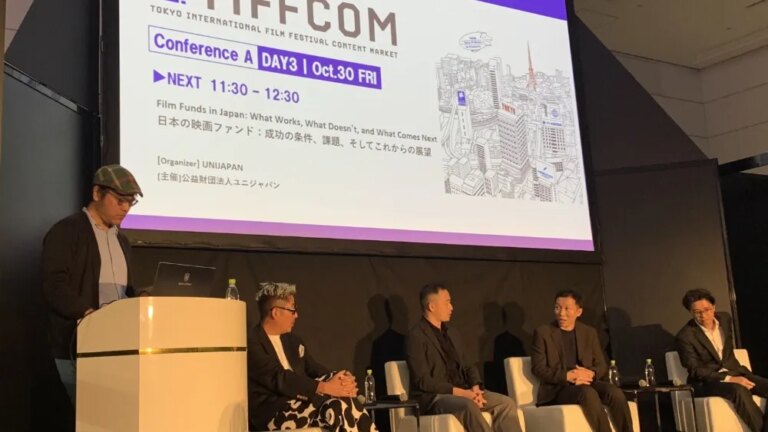
Japan‘s film industry is experiencing a transformative shift, as the traditional production committee system, where various companies collaboratively finance a film and share its rights, faces scrutiny for its limitations. While this model has spread risk across the industry, it often leads to restricted budgets tied to the financing capabilities of the industry itself, complicates overseas investment, and slows decision-making processes due to the need for consensus among multiple rights holders.
Exploring Film Funds as an Alternative
During a recent panel discussion at TIFFCOM, the content market of the Tokyo International Film Festival, industry experts examined how film funds could potentially alleviate these constraints while remaining aligned with Japan’s unique market dynamics. Entitled “Film Funds in Japan: What Works, What Doesn’t, and What Comes Next,” the panel featured insights from prominent figures such as Kii Muneyuki, CEO and producer of K2 Pictures; Ibe Tomonobu, CEO of Tokyo-based startup Questry; Nakagawa Keita, managing director at MUFG Bank; and Motoyanagi Yusuke, a partner at the law firm Nishimura & Asahi.
Innovative Financing Structures
Kii Muneyuki introduced the K2P Film Fund I as an emblematic example of a novel financing structure. Closed in February with approximately JPY5 billion ($32 million), the fund is designed to support around 50 films over a seven-year period. Operating as a blind pool, it allows investors to commit funds before specific films are selected. Investors include MUFG, the Development Bank of Japan, and various financial institutions, with approvals guided by a greenlight committee. Kii noted that by 2026, five films from the fund had already premiered in theaters.
A critical concern highlighted by Kii is the return on revenue for creators, particularly the distribution of income from streaming services and other formats following a film’s theatrical release. He pointed out that reliance on foreign box office performance is challenging, urging Japanese companies to diversify their business models beyond simple distribution.
Comparative Financing Models
The panel also compared film financing structures in the U.S. and South Korea. In the U.S., producers often leverage presales alongside completion guarantees to secure bank loans, where the latter ensures that a film is delivered on time and within budget, independent of its box office success. South Korea’s model, on the other hand, combines public and private support, with government-backed guarantees facilitating bank financing for projects.
In addition, Nakagawa introduced a feasibility study commissioned by the Ministry of Economy, Trade and Industry, which MUFG was selected to execute. Set to run through February 2027, this study aims to analyze real-world data to develop models for valuation and completion guarantees and to streamline the entire process from application to contract drafting. While the study assesses feasibility, it does not promise that financing or completion guarantees will become accessible.
Priorities for Future Development
The discussion concluded with the identification of four priorities moving forward: regulation, capital, creators, and cross-border business. Critical aspects include clarifying which regulations can be adapted, merging debt with subsidies and completion guarantees, and systematically integrating creator returns into fund structures. Furthermore, the panelists highlighted language and tax challenges that impede cross-border investment, particularly the “permanent establishment” rules that may expose international investors to Japanese tax liabilities.