SPOILER ALERT: This story contains minor spoilers for “Whalefall,” out now in theaters.
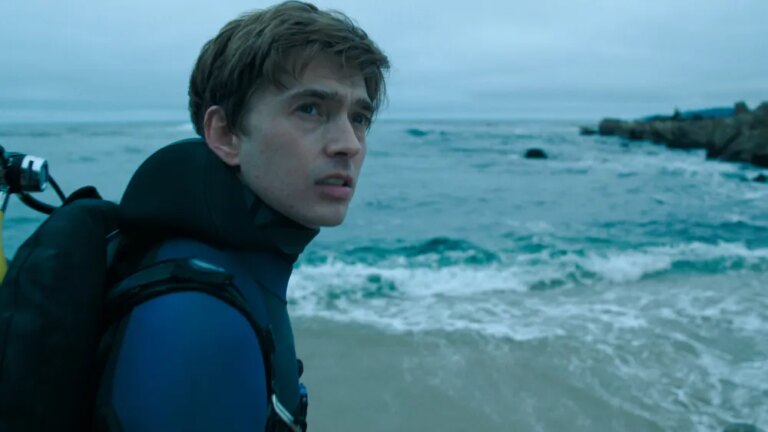
The new film “Whalefall” takes viewers on a gripping journey with Jay (Austin Abrams), a son mourning the loss of his father (Josh Brolin) as he searches for his remains off the California coast. As Jay dives deeper into the ocean, he becomes entangled in a battle between a colossal squid and an imposing 80-foot, 60-ton sperm whale. In a twist of fate, Jay gets sucked inside the whale just as he confronts the squid, leading to a harrowing fight for survival. With only an hour of oxygen remaining, Jay must navigate the dark belly of the whale to escape.
What unfolds is a tense and claustrophobic adventure, shaped by Brolin’s voice and evocative flashbacks that guide Jay through his ordeal. “It’s an intense experience, and that’s what we were going for,” says production designer Ramsey Avery.
Realistic Whale Set Design
Avery’s commitment to authenticity is evident in his creation of practical whale sets, including an impressive 30-foot whale head mounted on an animatronic arm, complete with a functional tongue that can open and close. The ambitious filming process incorporated water and practical effects, with the whale’s interior design evolving based on Jay’s whereabouts within its body. Avery highlights that intensive research was paramount to their design journey.
Collaboration and Research
Avery began his research by reviewing autopsy photos of sperm whales and collaborating with Dr. Joy Reidenberg, a biomedical research scientist. “She shared with me autopsies in the morning. I would get up at 6 a.m., look at autopsies with her as she was cutting open whales and explaining things to me,” he recalls. However, understanding the internal structure of a living whale was an entirely different challenge.
“As we discovered, our knowledge was somewhat limited. However, we do have cameras that go into the bellies of orcas, dolphins, and porpoises, providing us with a starting point on how they look when filled with fluids and in motion,” Avery adds.
Constructing the Whale’s Stomach
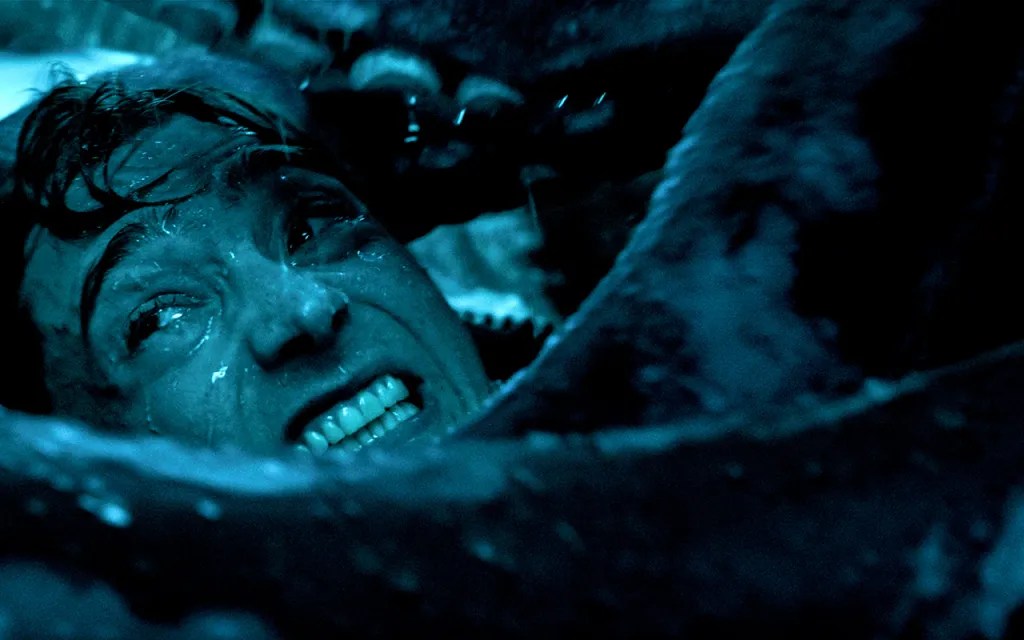
Avery named the primary set “stomach number one,” where Jay spends a significant portion of his time. With a vision of having everything submerged in water, he constructed a 60-foot-wide and 20-foot-deep tank. “We ended up building about 30 feet of the whale’s head that we could put into the tank, featuring an articulating mouth,” Avery explains. He coordinated closely with stunt and rigging teams, along with cinematographer Aaron Morton, to keep as much footage in-camera as possible.
To create the stomach’s realistic feel, Avery used upholstery foam of varying thicknesses and multiple layers of translucent, colored silicone to simulate a viscous environment. The outer shell consisted of heavy-duty canvas coated with glue for added rigidity while maintaining flexibility. “This made the stomach look alive,” he emphasizes. The final design required some digital effects from Weta Workshop, but it was robust enough to withstand weeks of filming with water, stunt performers, and camera crews.
Simulating Whale Movement
To authentically capture the whale’s motion, Avery experimented with different techniques. Initially, he considered using pistons or ropes, but those methods proved unfeasible for simulating the whale’s rise and dive. “We had four different stomachs on different rigs to achieve this,” he notes. “Our main stomach was on a small rig that constantly kept the whale in motion, while a secondary spinning rig mimicked the whale’s rotations.”
Depicting Stomach Conditions
In a particularly striking sequence, Jay finds himself immersed in the whale’s stomach bile, with colors carefully selected to reflect real-life anatomy. “The back of the throat is white, the first stomach—the chewing stomach—is muscular and white with subtle pink tones. The second stomach, housing its red acids, appears pink,” Avery explains. This palette thoughtfully mirrors Jay’s emotional journey in the film, transitioning from a sense of safety to a feeling of dread.
Moreover, creating the bile’s dense texture was another intricate task. Avery adds that director Brian Duffield wanted it to feel as if Jay had to struggle to move through it. Using methyl cellulose mixed with various additives, they created a texture reminiscent of oatmeal, complemented by silicone debris to simulate floating objects. Additionally, a large teeter-totter rig facilitated dynamic movements, enhancing the illusion of the whale diving and the stomach acids swirling around Jay.