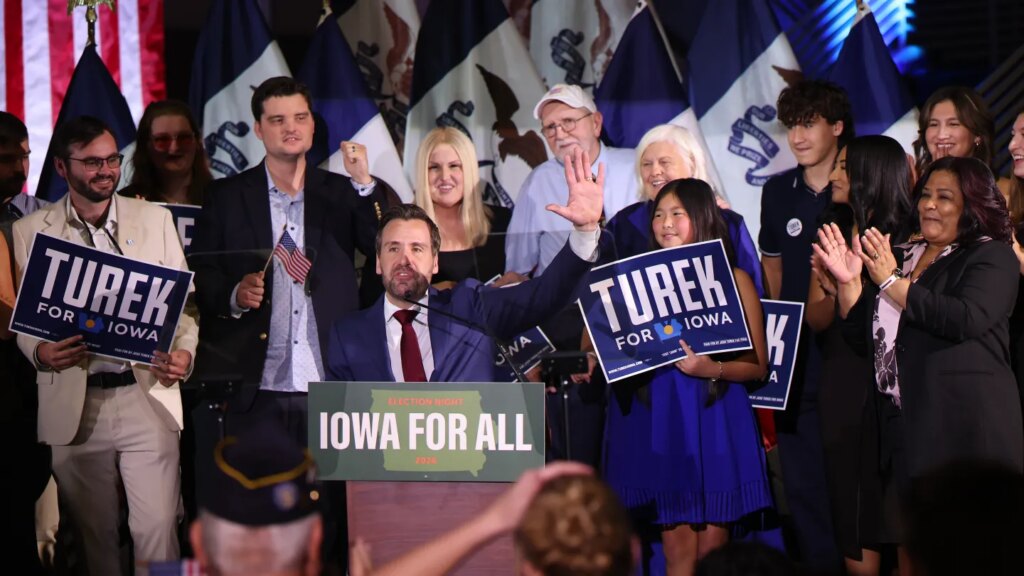
Following a historic election night, Democrats celebrated their significant victories while simultaneously evaluating the results and strategizing for future success. Jane Kleeb, a vice chair of the Democratic National Committee (DNC) under Ken Martin and the leader of the Association of State Democratic Committees, played a key role in this triumphant movement, leading efforts that resulted in victories across numerous races.
A longtime activist hailing from Nebraska, Kleeb expressed both excitement and pragmatism after the elections. We spoke with her to dissect the outcomes and implications for the Democratic Party moving forward.
Surprises and Resounding Wins
When asked about the unexpected nature of some races, Kleeb stated, “I definitely thought we were going to win the House and the Senate back because I knew the quality of candidates and the infrastructure we were building. I thought we would win some governors’ races and break some supermajorities at the state legislative level as well.” However, she admitted that the victory margins were larger than anticipated. “In some of these races it wasn’t one or two percentage points; it was five or six or more. So it was a resounding victory, not just voting against Trump.”
Building Momentum Beyond Anti-Trump Sentiment
Kleeb rejected the notion that this election was primarily an anti-Trump reaction. “When I was watching some pundits last night people were pontificating saying this was just a rebuke to Trump. No question it was, but it was also because Democratic organizers everywhere and candidates who looked and sounded like their communities were also fighters. So it was all of those factors.”
Reflecting on the party’s journey, she acknowledged a turning point: “I think it’s because our candidates this cycle thought they had nothing to lose. That Donald Trump was such a threat to democracy that they were putting everything on the field.” This mindset shifted the landscape beyond targeted battleground states.
The Realities of Past Elections
Kleeb noted the necessity of experiencing setbacks in order to spark recovery. “There’s no question we had a major reality-check as a party in 2024.” Past elections highlighted deep divisions within the party, demonstrating a struggle to effectively communicate its achievements. “We couldn’t figure out how to communicate to the American people all of the good things we were doing. So we hit the bottom. When Trump won again, we saw communities we frankly took for granted — Black voters and young voters and Latino voters — see Trump as a change agent.” This realization catalyzed a renewed effort to show voters that Democrats are advocating for genuine change.
California’s Challenges and the Billionaire Tax
While the Democrats found significant success in many areas, Kleeb recognized challenges in places like California, where a billionaire tax initiative appeared to be failing. “If the tax fails it could be for a lot of reasons. Maybe it’s that people don’t like taxes,” she speculated.
Ultimately, she mentioned the confusing layout of the ballot, which featured competing measures that appeared similar. Despite these setbacks, she remains convinced that voters want accountability from the billionaire class, suggesting alternative approaches for achieving this goal.
A Decentralized Victory Approach
Unlike past Democratic victories, such as Obama’s in 2008, where a singular figure led the charge, this election showcased a grassroots approach. “The difference this time was definitely the story of a team instead of a lead actor,” Kleeb explained. Reflecting on lessons learned, she emphasized the importance of investing in state and local infrastructure rather than relying solely on high-profile personalities. “We learned the hard lesson that it’s this infrastructure model that works and we saw that this time.”
Surprises and Looking Ahead
Kleeb acknowledged surprisingly close races in unexpected places, particularly in Mississippi, where Brandon Presley almost won the governorship despite minimal resources. She praised the creativity and effectiveness of campaigns, such as Scott Colom’s viral political ads, showcasing the power of grassroots efforts.
As the Democrats look forward, they face the challenge of allocating resources wisely across states once considered out of reach. Kleeb remains optimistic, asserting, “There’s plenty of money in the political system,” emphasizing the need for consistent, year-round infrastructure in every state.
Embracing Diversity Within the Party
Looking ahead, the Democrats must navigate internal dynamics, balancing the perspectives of moderates, progressives, and far-left activists. Kleeb views this diversity as a strength, stating, “I think having progressives and moderates gives us an advantage because we’ll have durable long-lasting policies that all kinds of Americans will embrace.”
As the party moves forward, it will need to maintain unity and continue building on the momentum generated by this historic election.