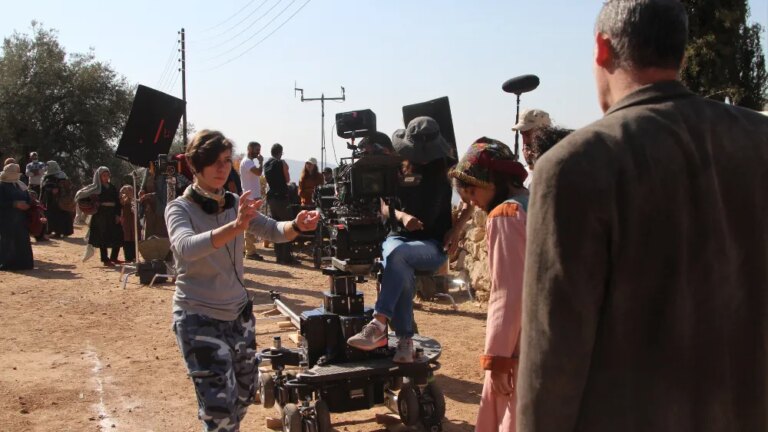
Palestinian-Jordanian filmmaker Darin J. Sallam stands firm in her commitment to storytelling, proudly reflecting on her debut feature, “Farha.” The film, which captures the coming-of-age journey of a Palestinian girl amid the Nakba—the mass displacement of Palestinians during the establishment of Israel in 1948—has not only garnered international attention but also sparked considerable controversy.
Fearless in the Face of Criticism
Despite warnings that tackling such a sensitive subject could jeopardize her nascent career, Sallam expresses no regrets. Speaking from the UAE, where she serves on the narrative features jury at the 13th Sharjah International Festival for Children and Youth, she stated, “I never questioned that decision or regretted it for a moment. Everything that went into bringing the film to life was worth it, and its impact continues to resonate to this day.”
Inspiration Behind “Farha”
The narrative of “Farha” was inspired by her mother’s recounting of a Palestinian refugee’s ordeal. After its premiere at the Toronto Film Festival in 2021, the film was selected as Jordan’s submission for the international feature Oscar and subsequently became available for streaming on Netflix. However, its release on the platform led to a backlash due to a harrowing scene depicting Israeli soldiers killing a Palestinian family, prompting public condemnation from Israeli officials and harassment directed at Sallam and her team.
A Deeply Personal Approach to Cinema
Sallam remains deeply committed to storytelling that emphasizes personal experiences. She believes that history is best understood through individual narratives: “Personal stories are often the most powerful way to understand history and society,” she elaborates. In “Farha,” the larger collective experience of the Nakba is distilled through the eyes of a young girl, offering audiences a relatable entry point into the traumatic events that reshaped countless lives.
Exploring Women’s Stories
Sallam expresses a particular affinity for women’s stories, acknowledging how many have been overlooked or silenced throughout history. Her conviction that “cinema needs to emerge from a genuine human experience” drives her to craft stories that not only convey messages but resonate on an emotional level. “If cinema is not personal, it risks becoming nothing more than slogans and history lessons,” she asserts.
Next Project: “Churching of Women”
Following the impactful journey of “Farha,” Sallam is now turning her attention to her second feature, “Churching of Women.” Set in the Levant during 1938, this new film follows Fadia, a pioneering female author who faces grave injustices, including confinement in a mental asylum by a cousin who seizes her inheritance. This project has already won acclaim, having participated in the Busan International Film Festival’s Asian Project Market where it garnered the ArteKino International Award.
Determined to continue exploring themes of injustice and support among women, Sallam notes that the new film will delve into colonial power structures and the complexities of grief. “With ‘Churching,’ I’m exploring our story setups on a broader, more complex scale,” she explains, excited by the opportunity to work with multiple characters.
Lessons from “Farha”
The experience gained from producing and releasing “Farha” has equipped Sallam and her team with valuable insights that they are applying to “Churching of Women.” Rather than causing hesitation in her storytelling choices, her journey with “Farha” has solidified her resolve to share compelling narratives. “I cannot wait to share ‘Churching of Women’ with audiences,” she adds, eager to introduce its unique characters and the intricate world they inhabit.
Engaging Young Audiences
Sallam’s role at the Sharjah International Film Festival has deepened her appreciation for younger audiences, whom she believes possess the emotional maturity to engage with cinema in meaningful ways. “I am always moved by the curiosity and emotional maturity of young audiences,” she reflects, emphasizing the potential of children and adolescents to connect with powerful storytelling.
As she moves forward in her career, Darin J. Sallam remains a passionate advocate for authentic narratives that shed light on overlooked histories, particularly those of women, paving the way for future filmmakers to follow.