In a significant development for the Indian film industry, Sudhan Sundaram, producer of the Tamil thriller “Maharaja,” announced during a panel at the WAVES Film Bazaar that a Hollywood agency has approached him for the film’s remake rights. This event took place amid the ongoing 57th International Film Festival of India (IFFI) in Goa, and it highlights the increasing global appeal of Indian film intellectual property (IP).
Maharaja’s Box Office Success
Produced by Sundaram, who is the founder of Chennai-based Passion Studios, “Maharaja” has achieved impressive box office results, reportedly grossing around INR 910 million (approximately $9.6 million) in China. This accomplishment underscores the film’s international traction and the potential for Indian stories to resonate with global audiences.
Insights from Industry Leaders
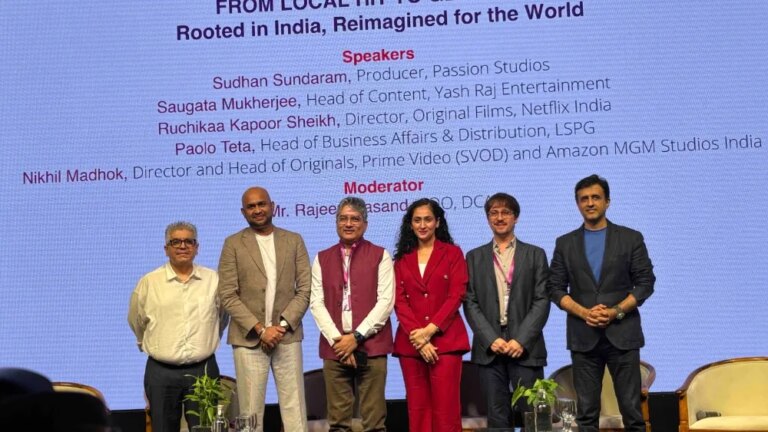
The panel discussion, titled “From Local Hit to Global IP: Rooted in India, Reimagined for the World,” was moderated by renowned film critic Rajeev Masand and included prominent figures such as Nikhil Madhok from Prime Video, Saugata Mukherjee from Yash Raj Entertainment, Ruchikaa Kapoor Sheikh from Netflix India, and Paolo Teta from LSPG. The speakers praised “Maharaja’s” success, indicating a growing recognition of Indian storytelling on the global stage.
Indian Stories on the Global Stage
Madhok emphasized that while Indian stories are beginning to travel internationally, they have yet to achieve the kind of breakthrough moment that has been seen with Korean content. He stated, “What we see with Korean content, that breakthrough moment hasn’t happened for India yet. The journey has begun, and we’re well on the path to doing that.” He noted that authentic, locally rooted stories have a better chance to stand out. Shows like Prime Video’s “Made in Heaven” and “Raakh” exemplify this trend, having surpassed expectations internationally.
Kapoor Sheikh remarked on India’s historical strength as a storytelling powerhouse, highlighting how streaming platforms have diminished language barriers. “Revenge, love, first love, heartbreak, a mother’s love for a child – these are so universal that we’re hoping the audience comes back to that world to continue exploring it,” she explained, raising questions about the definitions of local versus global storytelling.
The Evolution of Film IP
Mukherjee pointed out that classics such as “Mother India” (1957) and “Dilwale Dulhania Le Jayenge” (1995) have been international successes for decades. He acknowledged the blurring lines between local and global with the advent of streaming platforms, stating, “Have the IPs traveled? Have we got a show which is being remade into 50 other languages? Not yet.” This indicates the necessity for Indian stories to not only reach international audiences but to also be adapted for other markets.
Franchises vs. Standalone Films
The discussion also delved into the trend of franchises, with Madhok expressing the view that the focus should first be on creating compelling standalone films. “The first priority must be to make a compelling film and establish its characters, with an extension following only if there is another worthwhile story to tell,” he stated. Mukherjee echoed this sentiment, suggesting that some stories thrive when they remain contained rather than being stretched into franchises driven solely by commercial interests.
Opportunities in Animation and Legal Frameworks
The panelists also recognized animation as a viable avenue for Indian storytelling, given the country’s rich tapestry of folklore and cultural traditions. Teta emphasized the importance of understanding legal and commercial frameworks from the outset, which can help filmmakers make informed choices regarding their work. His advice to producers was clear: “Come to the lawyer early. If you come late it might be too late and expensive for you,” particularly when it comes to negotiation of adaptation and remake rights.