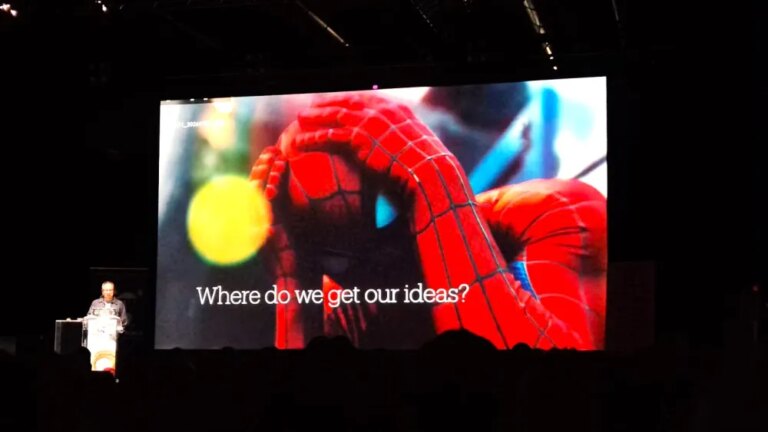
Creating the visual effects for Marvel and Sony’s “Spider-Man: Brand New Day” presented a monumental challenge, overcoming the limits of time and technical expertise. VFX supervisor Jerome Chen revealed intriguing details about the film’s ambitious production during his presentation at the View Conference in Turin. The production involved almost 2,000 VFX shots and an aggressive post-production timeline of just 24 weeks. In a remarkable feat, 445 shots were delivered in a single week—an achievement Chen compared to his first film in 1999, which took two years for a total of 450 shots.
Intense VFX Work in a Tight Timeline
Remarkably, around three-quarters of the film’s VFX work was completed in the final six weeks of post-production, which intensified an already demanding schedule. Chen noted that preparations for the film began with a scouting trip to New York in December 2024, prior to receiving the finished script. The director, Destin Daniel Cretton, aimed for a more grounded, street-level portrayal of Spider-Man, ensuring that the city played an integral role in the narrative. Most filming, however, occurred in the UK, with Pinewood Studios in London and Glasgow standing in for New York.
Crafting a Realistic New York
Using production designer Charles Wood’s concept art, the team established a restrained color palette, punctuated by vibrant shades during key emotional moments. They preserved usable street-level photography while digitally enhancing much of the overhead backgrounds. Chen shared that they developed a specific formula of elements to signify New York—things like hanging traffic signals, scaffolding, water towers, and power lines were key markers. Even the yellow markings typically found on British curbs had to be digitally removed to maintain authenticity.
Transforming the Hulk
Chen’s tenure on this project marked his first opportunity to redesign the Hulk, portrayed by Mark Ruffalo. Due to the character’s new portrayal as more savage and telepathically controlled, the team sought to alter his physique, including adjustments to muscular definition, hair color, and proportions of his hands and feet. Chen consulted with Marvel Studios president Kevin Feige about the Hulk’s visual evolution throughout the franchise, which resulted in substantial changes to the character’s appearance, including a more naturalistic look at smaller details, like his toenails.
Creative Challenges and Solutions
Notably, small script elements became significant technical challenges. For instance, an introductory scene featuring Spider-Man and a tank expanded from a few words into 11 shots, totaling 52 seconds of film. The crew utilized physical tabletop models to plan complex action sequences. In one instance, a compact camera rig helped capture close-up shots of Tom Holland’s performance, with unique compositing techniques suggesting the inside of his mask. “Sometimes the easiest tricks are the most effective,” Chen mused.
Reflecting on Visual Effects Quality
Chen noted that the ultimate quality of visual effects is often dictated by time constraints rather than the skill level of the artists involved. “If you go to a movie and you see that there’s a visual effects shot that doesn’t look that good, it’s not because there are bad artists on it,” he explained. “You can tell they just ran out of time.” His advice for supervisors was to focus on viewing sequences in their entirety rather than fixating on individual frames.
Final Touches and Industry Implications
The rapid completion of the film raised concerns about the implications for the industry as a whole. “We may have done ourselves a disfavor by actually finishing this movie in 24 weeks because once again we’ve proven that it can be done on time,” Chen reflected. Remarkably, the final challenge was addressing a minor detail. A last-minute review found a sweat stain under Spider-Man’s arm, which the team quickly corrected. “You can’t have superheroes sweating into their suit,” Chen said, detailing how a small team was able to fix the issue in just 47 minutes before he left the studio.