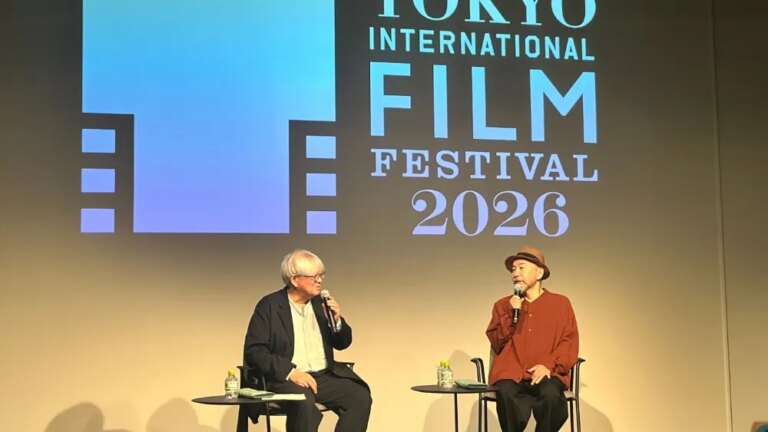
Renowned independent filmmaker Tsukamoto Shinya recently captivated audiences during a masterclass at the 39th Tokyo International Film Festival (TIFF), where he discussed pivotal milestones in his cinematic career and introduced his latest project, the English-language film “Mr. Nelson, Did You Kill People?”
Legacy of Innovation and Independence
While Tsukamoto is perhaps best recognized internationally for his groundbreaking 1989 feature, “Tetsuo: The Iron Man,” he revealed that his passion lies in working outside conventional studio systems. Moderator Ichiyama Shozo, TIFF’s programming director, described “Tetsuo” as a “shock,” emphasizing that its quality was unexpected from the Japanese independent film scene of that era.
Reflecting on the film’s production, Tsukamoto mentioned that it was shot on 16mm before the advent of digital visual effects. “No CG. We had a little bit of tokusatsu [practical special effects] technology at the time but this didn’t use any of that; it used stuff which was thrown out on the street, and we basically stuck it on [Taguchi Tomorowo]’s face,” he recalled. He urged attendees to consider Taguchi’s movements through the streets as a form of “really rough stop motion.”
The film was a year-long endeavor, although Tsukamoto spent a significant portion working alone as he neared completion. The positive reception to “Tetsuo” opened doors for him to showcase his work at international film festivals, leading to the production of his second feature, the horror film “Hiruko the Goblin,” which operated on a larger budget.
The Choice of Independence
When asked by Ichiyama about the pressures of creating a larger-scale film, Tsukamoto reflected that his diverse experiences, including work in commercials, helped him handle those challenges. Over the years, he has consistently chosen to produce films independently, such as “Bullet Ballet” and “Tokyo Fist.”
“I did receive offers [from studios], but I didn’t want to become a director for hire; I didn’t think that suited me,” Tsukamoto explained. “There are certain things you want to do as a filmmaker… I think my impulse as a creator is stronger with my own material, which is why I went down that path.”
His independent spirit is also evident in his 2014 war film “Fires on the Plain,” which he filmed partly in the Philippines and Okinawa. Tsukamoto passionately expressed that adapting this story was a long-held dream. “I wanted to do this from my teens to my 20s to my 30s; I even went to the Philippines to try [to] finance it in my 40s,” he shared.
The Challenge of Self-Distribution
Tsukamoto faced significant hurdles in bringing “Fires on the Plain” to life and even explored self-distribution. “The people involved… it was hard work for them, so I wouldn’t wanna do it again, but it’s something I wanted to do for a long time,” he said. Initially considering smaller screenings, he was encouraged to expand the release to 80 cinemas after starting with 40.
Due to time constraints, the discussion shifted to his recent film “Mr. Nelson, Did You Kill People?,” which is Tsukamoto’s second English-language film since 2009’s “Tetsuo: The Bullet Man.” The story follows Allen Nelson, a New Yorker who grapples with his past as a Marine in Vietnam, featuring actors such as Rodney Hicks, Geoffrey Rush, and Lily Franky.
Tsukamoto discovered this narrative while working on “Fires on the Plain,” but faced delays due to the COVID-19 pandemic and the Hollywood actors’ strike. This led to his releasing “Shadow of Fire,” which was initially slated for after “Mr. Nelson.” The entire development of “Mr. Nelson” took around seven years.
Filmmaking Philosophy
During the audience Q&A session, Tsukamoto shared insights into his filmmaking philosophies and thoughts on contemporary independent cinema. He advised young filmmakers to leverage digital technology, emphasizing how it can redirect budgets from film processing towards creativity. “Anything is a canvas now… YouTube shows what can be learned and accomplished without a budget,” he noted.
When asked about future projects, he reiterated that while he did not anticipate lingering on the theme of war, he was compelled to do so due to the state of the world. “I wanted to alleviate some of the darkness I was experiencing,” he revealed. “I don’t think I can pry myself away from it.”
Tsukamoto attributed his ability to juggle multiple roles in filmmaking to effective communication and time management, coupled with his passion for the craft. “Filmmaking is an accumulation of everything I love,” he said. “It feels very close to drawing or painting to me,” he added, recalling his background in art as a source of inspiration and creativity.