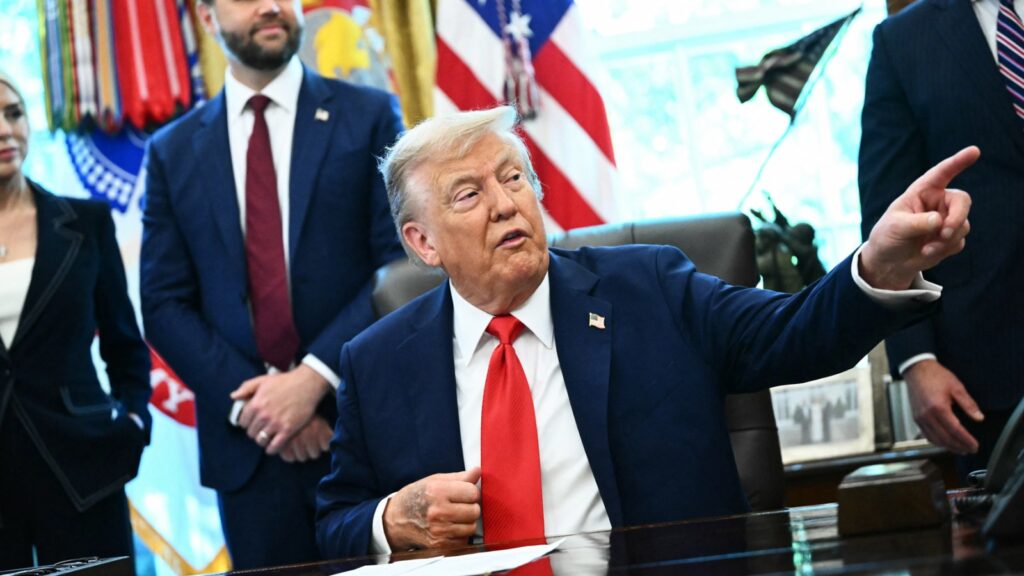
In recent discussions, the notion of leadership styles in the United States has taken a dramatic turn, with Donald Trump commenting on the preference for a dictatorial approach. During a recent session in the Oval Office, Trump hinted at the possibility of the U.S. transitioning towards a more authoritarian leadership, sparking debates across the nation. These statements have raised important questions about the balance of power and the implications of favoring a dictatorial government. In this article, we explore Trump’s remarks and the political dynamics surrounding this provocative idea.
Trump’s Thoughts on Dictatorship
During a session of signing executive orders, Trump addressed questions about his administration’s recent military interventions in Washington, D.C. Despite a decrease in crime, Trump suggested extending military presence to cities like Chicago, citing high crime rates and dismissing opposition from local leaders. “They say, ‘We don’t need him! Freedom! Freedom! He’s a dictator! He’s a dictator!’” Trump recounted. He followed this with his now-notorious comment: “A lot of people are saying maybe we’d like a dictator,” while also asserting he does not want to be one, attributing his actions to “common sense.”
Comments Stirring the Political Landscape
The rhetoric continued as Trump discussed perceptions at a Cabinet meeting. He acknowledged being labeled a dictator but argued his approach effectively tackles crime. “So, a lot of people say, ‘If that’s the case, I’d rather have a dictator.’ But I’m not a dictator,” he reiterated. Trump’s campaign statements for the 2024 election, where he humorously entertained being a dictator for a day, add layers of complexity to these claims. His suggestion that Americans might prefer abandoning democracy is causing considerable unease.
Challenging Traditional Checks and Balances
Trump’s tenure since retaking office has been marked by conflicts with Congress and the judiciary, illustrated by executive orders that challenge constitutional norms. From election interference to penalizing flag-burning, these actions show a readiness to sideline traditional checks and balances. Such moves resonate with Trump’s past admiration for autocrats worldwide, evidenced by praise for figures like Vladimir Putin and Kim Jong-un.
Voices from Trump’s Inner Circle
Former Trump officials have weighed in on this leadership style. John Kelly, ex-chief of staff, remarks that Trump’s governance aligns with dictatorial principles. “Certainly, in my experience, those are the kinds of things that he thinks would work better in terms of running America,” Kelly stated, adding fuel to the debate over whether a dictatorial approach is indeed preferable.
Amidst these tensions, the potential deployment of military forces in cities without governors’ consent remains contentious. Trump’s assertion, “I am,” in response to deploying to Chicago highlights his intent to push boundaries further, amplifying the debate on whether a transition to a dictatorship would benefit or harm the nation.