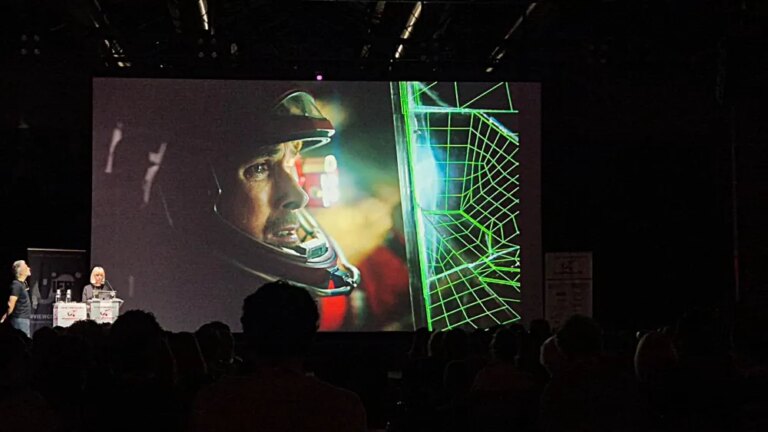
In the ambitious space adventure film “Project Hail Mary,” Ryan Gosling faces not only the perils of interstellar travel but also the challenge of performing in a convincing zero-gravity environment. Oscar-winning VFX supervisor Paul Lambert recently shared insights into the film’s visual effects at the View Conference in Turin, Italy, highlighting the complexities involved in creating a realistic portrayal of weightlessness.
The Challenge of Zero Gravity
“Zero-G was probably my personal biggest concern going into the movie,” Lambert stated, reflecting on the hurdles the production team faced. To achieve authentic zero gravity, they initially suggested using the “vomit comet,” an aircraft that simulates weightlessness. However, the elaborate sets of the spacecraft made this impractical. Instead, Gosling filmed his scenes using wire rigs, including a rotating harness for added effect.
Enhancing Suspension and Movement
Removing the wires was only the first step. When Gosling appeared suspended rather than floating, VFX artists meticulously adjusted the positions of his limbs and added drifting objects to enhance the illusion of weightlessness. Lambert praised Gosling’s commitment to performing his own stunts, which included challenging spacewalk sequences.
A Hands-On Approach to Visual Effects
The visual effects team also embraced a hands-on experimental approach. Lambert described their unconventional methods, including the use of an infrared-modified camera, programmable lights, and water effects to achieve some of the film’s more surreal visuals. “It was literally a mad science lab,” he recalled, as they filmed various elements like burning fireballs, liquids, and lasers to serve as starting points for microscopic effects.
Postproduction Innovations
During postproduction, director of photography Greig Fraser worked with ILM’s Helios virtual-camera system to enhance sequences involving Gosling’s character. By tracking his performance on set, artists recreated it in digital environments, allowing Fraser to explore different camera angles without losing the integrity of the original performances.
Grounding Science Fiction in Reality
Lambert and co-supervisor Mag Sarnowska aimed to keep the film’s scientific imagery grounded and relatable. Instead of creating extravagant nebulae, they utilized astronomical data and practical puppetry to maintain a believable aesthetic. “We had visions of all these beautiful nebulae, but in the end, the skies were pretty much as we see them today, from Earth,” Lambert explained, referencing their research for the adaptation of Andy Weir’s novel.
Data-Driven Star Mapping
The visual team relied on data from the European Space Agency’s Gaia mission to accurately map the stars in the film’s setting, situated 11.9 light-years away from Earth. Lambert noted how studying NASA footage and International Space Station imagery influenced their understanding of camera behavior in orbit. They chose to reflect actual lighting and exposure conditions, which meant stars would be less visible near bright planets.
Textural Choices and Virtual Exploration
Fraser’s vision stretched into the film’s textural composition. The team digitally captured footage printed onto Kodak film, opting for specific stocks to create varying textures that represented Earth and space. Additionally, two months of virtual production exploration prior to filming allowed for experimentation with lighting and camera movements, ultimately guiding the actual shoot and subsequent VFX processes.
Making Rocky Come to Life
The character of Rocky, an alien companion performed by James Ortiz and a team of puppeteers, presented its own set of challenges. Sarnowska discussed various practical versions of Rocky, including animatronics and reference puppets, emphasizing the need for the full CG version to emulate the puppeteers’ movements. “In the end, half of the Rocky shots were puppet and the other half CG,” she shared, highlighting the collaborative effort required to achieve seamless interactions.
Moreover, the effects crew digitally reconstructed Rocky’s transparent barriers to remove reflections and maintain complex light interactions within the set. To depict Rocky’s sonar-based perspective, the filmmakers experimented with different film formats, ultimately choosing 10mm and 16mm to create an organic texture and enhance the film’s narrative of interstellar friendship, contributing significantly to its success at the box office.