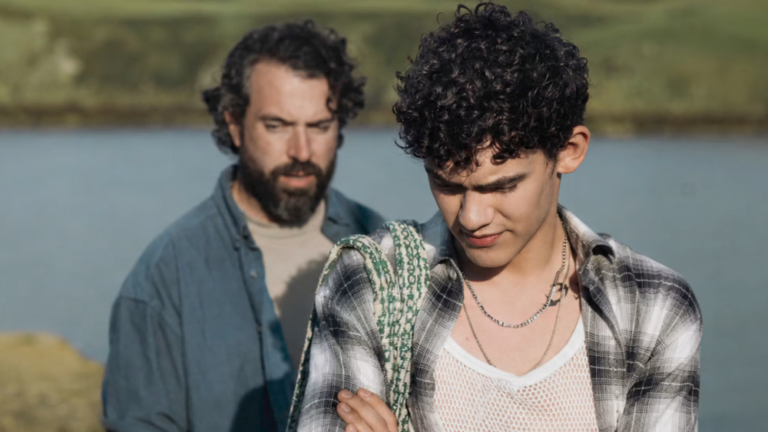
As anticipation builds for the upcoming film “Hunger Games: Sunrise on the Reaping,” production designer Uli Hanisch found himself wrestling with the challenges of maintaining secrecy amid the fervor of ardent fans. The decision to film in the remote town of Asturias, Spain, seemed like a stroke of genius; shooting would take place in a desolate valley that required a lengthy trek to access, far away from traditional hotel accommodations and dining options. However, that reassurance quickly dissipated.
“We had the experience from last time where fans were following us to Poland trying to take pictures, but up there, it’s nothing, it’s just us,” Hanisch told Variety. Yet, only two days into the shoot, the first images emerged online, leaving Hanisch astounded. “I was like, ‘How is that even possible?’”
While he initially questioned whether a crew of the required scale could traverse such a secluded location, he quickly became captivated by the stunning landscape. The verdant greenery juxtaposed against the rugged mountains confirmed that they had discovered the perfect arena for the Second Quarter Quell.
“I stepped out of the car and looked into the valley and said, ‘God damn, yeah, that’s it,’” Hanisch recalls. He promptly sent a photo to director Francis Lawrence, declaring, “Look, this is our valley, but it’s really far away.” Lawrence’s response was simple: “Yeah, well, we have to do it here.”
Cultivating a Dangerous Beauty
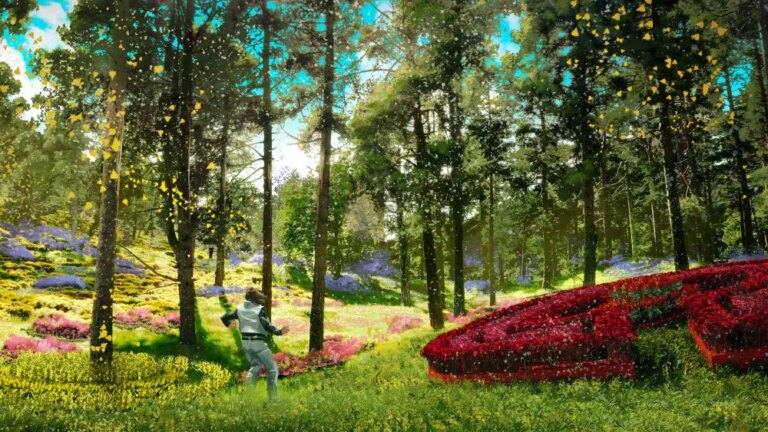
A key challenge Hanisch and his team faced was designing the Cornucopia, the central structure that distinguishes each iteration of the Hunger Games. They sought to create a piece that balanced beauty with a sense of foreboding; their concept—a blossom adorned with metal spikes as petals, encircled by arrangements of wildflowers—reflected this duality.
“It’s very beautiful, it’s very elegant, but it also looks very deadly and evil,” Hanisch explains. He noted a striking visual when tributes clad in capes surrounded the Cornucopia, resembling a scene from a “satanic, strange cult”; an appropriate match for the tone of the film.
As the games unfold, tributes venture beyond the menacing structure into a lavish woodland environment, where the foliage is as dangerous as it is sumptuous. To recreate this scene, Hanisch’s dedicated team, consisting of just six members, spent three weeks embellishing the arena, utilizing approximately 600,000 artificial flowers alone.
“We underestimated it. What you see in the movie is still enhanced by visual effects,” Hanisch admits.
The team also devised clever mechanisms such as the berms—mechanical bushes that serve as entry points for mutts and a conduit for Haymitch (played by Joseph Zada) to destroy them.
“Oh, the berms!” Hanisch exclaims. “We had to come up with some kind of sensible thing on our own to make it work. It’s hard to tell that as an interesting story because it’s a very long, time-consuming, tiring process.”
Returning to District 12
For Hanisch, recreating District 12 was akin to “coming home.” The crew returned to the same abandoned steel mill in Germany where they filmed the prequel “The Ballad of Songbirds and Snakes,” once again capturing the dreariness of the impoverished district.
“We agreed that District 12 never changes, which I like very much,” he shares. Filming close to his hometown of Nuremberg imbued the experience with a personal touch: “It’s very beautiful, actually, very intense and complex. I know every corner there.”
Visualizing the Capitol
In imagining Panem’s Capitol, Hanisch held on to a feeling of familiarity rather than nostalgia. The 2023 prequel established the Capitol’s aesthetic as reminiscent of Berlin after World War II, reflecting the city’s torn history. This latest film, set two decades later, adopts a 1970s aesthetic to depict the Capitol at its zenith of power and arrogance.
“Berlin’s International Congress Center looks like a Star Wars spaceship landed in the middle of the city,” Hanisch remarks. With its imposing structure and strange futuristic style, this venue was ideal for the filmmakers seeking to capture the essence of the Capitol: luxurious yet menacing.
“We wanted to explore the capital of Panem at the peak of its power, wealth and arrogance,” he explains. This philosophy guided the film’s portrayal of the Capitol, a place defined by opulence and danger beneath its stunning surface.
Interpreting the Source Material
The filmmakers’ understanding of the 1970s emerges from the original works of Suzanne Collins and adaptations by screenwriters Billy Ray and Michael Lesslie. Hanisch acknowledges the challenge of translating literature into film, recognizing that each reader creates their own interpretation of the material.
“Every reader creates their own world while reading it, and you can never say your version is right and your friend’s version is wrong,” Hanisch states. “We cannot do anything else but what we think is right.”
Keeping the fans’ expectations in mind helps keep Hanisch grounded amid the pressure of working on a beloved series. “I find it so fascinating how important this is for so many people and how seriously they talk and think about it,” he expresses. “Of course, it’s my job, and I love to do that, and it’s a fantastic thing to be done, but it is mainly to make the fans happy. And they should be happy.”