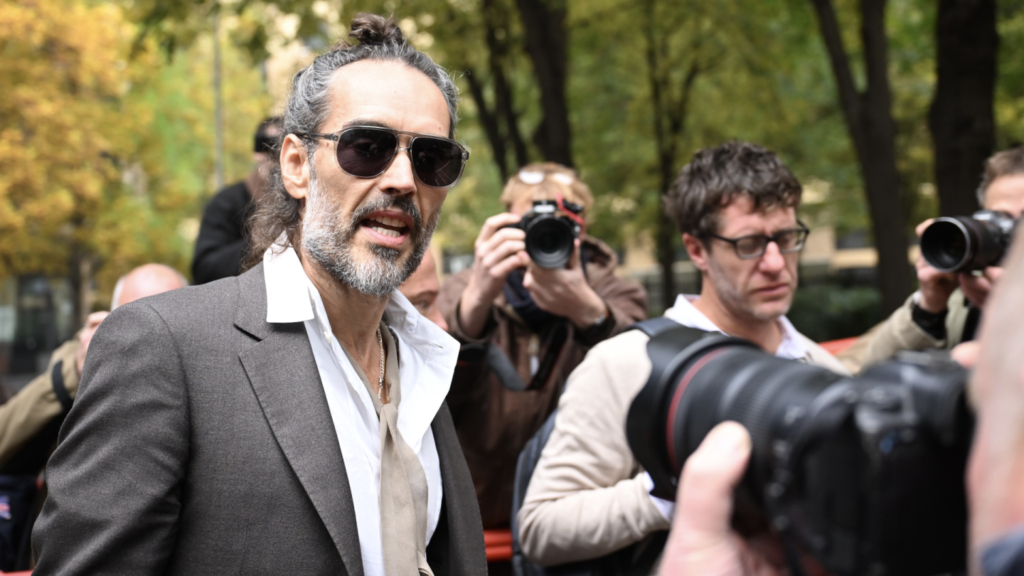
The prosecution has presented its closing arguments in the high-profile trial of comedian and presenter Russell Brand, asserting that his defense is built on “a lot of half-truths, but spun into lies.” As the jury, which consists of eight men and four women, prepares to deliberate, they have been instructed to reach a unanimous verdict on each count.
Charges Against Brand
Brand faces three counts of rape and three charges of sexual assault, with allegations dating from 1999 to 2009 made by six women. Although initially accused of indecent assault, a count of attempted indecent assault was later introduced by the judge. These testimonies detail serious accusations, including allegations that Brand raped one complainant in a Bournemouth hotel room after the Labour Party conference in 1999 and another whom he allegedly pulled into a toilet and orally raped in Soho in 2004. Another accuser has claimed that Brand anally raped her at his Hampstead home in 2009, following consensual sex. Further claims include Brand attempting to drag a colleague from MTV into a bathroom in 2001 and exposing himself to another individual during a car ride.
Testimonies and Court Proceedings
During the past three weeks, the jury has listened to the police interviews of the complainants, whose identities are protected throughout the trial. They have also heard cross-examinations, with testimonies from witnesses, including Brand’s former personal assistant, Helen Berger. Brand himself provided evidence just last week, stating he did not influence anyone to testify for him. His wife, Laura, took the stand shortly afterward, describing him as a “caring and kind, wonderful father” to their three children. In his defense, Brand affirmed, “I know what ‘no’ means… Consent is a fundamental, essential and necessary and in many ways more important than sex itself.”
Prosecution’s Arguments
Lead prosecutor Riel Karmy-Jones emphasized in her closing statement that the women do not know each other and none sought publicity from their allegations. She stated, “None of these women has anything to gain — except perhaps some closure.” Karmy-Jones urged the jury to consider the testimonies: all accusers described moments when Brand’s behavior changed dramatically, transitioning from friendly to abusive. She highlighted their accounts of being ignored when they expressed their unwillingness, stating, “[Brand] didn’t listen when I said no, he didn’t listen, he didn’t care… In the rape cases, he just kept on going until he achieved his ultimate aim and ejaculated.”
Karmy-Jones remarked that while the complainants have moved forward with their lives, the trial has forced them to recount painful experiences in detail, emphasizing that they should not be viewed as “jealous women spurned.” She pointed out that memory lapses about what they wore at the time of the incidents do not diminish their credibility. In contrast, she noted Brand’s recollection of many encounters has improved since his initial police interviews.
Brand’s Character and Prosecution’s Closing Statements
At one point during the proceedings, a member of the audience fell asleep in the gallery, briefly interrupting the courtroom. Karmy-Jones dismissed the notion that the Channel 4 documentary series Dispatches, which brought the allegations to light and prompted the investigation, manipulated the women into revising their memories. Rather, she argued, it enabled them to discover they were not alone and motivated them to testify with courage.
To emphasize the severity of the situation, Karmy-Jones asked the jury to sit in silence for 20 seconds, which was the duration one woman claimed her encounter with Brand lasted. She also acknowledged Laura Brand as a “undoubtedly lovely” person but pointed out that she and Russell were not in contact at the time of the alleged incidents.
Final Thoughts from the Prosecution
Referencing Brand’s earlier statements regarding consent, Karmy-Jones questioned, “Does that ring true?” She cited a passage from Brand’s 2007 autobiography My Booky Wook, where Brand wrote about his determined approach in pursuing what he desires, indicating consent might have been viewed as “just an obstacle to be removed, or perhaps to ignore.” Karmy-Jones concluded by asserting that there was a pattern in Brand’s behavior where he tended to “swiftly make things sexual.”
As court proceedings adjourned, the defense is expected to present their closing arguments on Monday.