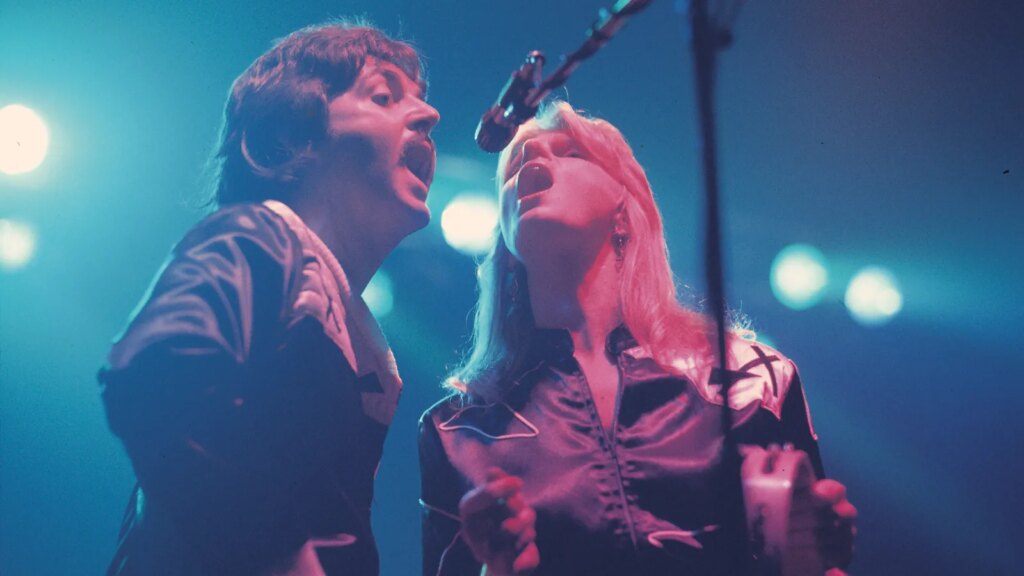
Exactly 50 years ago, Paul McCartney concluded his “Wings Over the World” tour, marking a pivotal moment in his post-Beatles career. The grand finale took place at Wembley Arena on October 19, 1976, where McCartney and his band delivered a stunning performance, showcasing their evolution from humble beginnings to rock icons. Just four years earlier, McCartney had been struggling to find his footing with Wings, playing small venues and facing skepticism from critics.
From Humble Beginnings to Stardom
In 1972, Wings took the stage for their initial tour in Ollioules, France. With McCartney re-entering the live music scene after the Beatles’ final performance in 1966, expectations were tentative. Critics like Guardian writer Robin Denselow were harsh, describing the concert as “one of the most depressing, almost embarrassing concerts I can remember.” He attributed the band’s disarray to Linda McCartney’s nervousness and lack of talent, claiming the performance was “out of tune, awkward, and generally dreadful.”
While Denselow’s critique reflected the broader disappointment of fans, it didn’t align with the reality of the early Wings setlists, which primarily featured material from their 1971 album, Wild Life. McCartney avoided playing Beatles songs, keen to establish Wings’ identity away from his legendary past.
A Transformative Tour
Fast forward to 1975, and the landscape had transformed significantly for McCartney and Wings. The success of Band on the Run and Venus and Mars introduced several hit songs, allowing the band to evolve their setlist dramatically. Tracks like “Jet,” “Let Me Roll It,” and “Live and Let Die” became staples, enhancing their appeal in arenas worldwide. The previously reluctant McCartney finally embraced his Beatles legacy, incorporating a few iconic songs into the set as fan demand surged.
The Grand Finale
By the time Denselow walked into Wembley Arena, he was greeted by a vastly different band from the one he’d previously criticized. “They played non-stop for more than two hours and gave one of the happier, most exhilarating, and most brilliant rock concerts London has seen in recent years,” he remarked, praising the professionalism and meticulousness of the performance. After over a year of touring, Wings had finally gelled into the cohesive unit McCartney had envisioned.
The concert opened with several hits, including “Venus and Mars/Rock Show” and “Jet.” McCartney then nostalgically introduced “Lady Madonna,” a Beatles classic. For many in attendance, it was their first experience seeing a former Beatle perform live.
A Mix of Classics and Original Hits
After thrilling the audience with “The Long and Winding Road,” performed in its original, stripped-down form, McCartney brought out even more iconic tracks. Linda McCartney humorously introduced “Richard Cory,” a cover performed by Denny Laine, before McCartney took the mic again for a trio of Beatles masterpieces: “I’ve Just Seen a Face,” “Blackbird,” and “Yesterday.” Each performance ignited ecstatic reactions reminiscent of a previous era, delivering a nostalgic experience for the audience.
However, McCartney limited himself to five Beatles songs during the diverse show, ultimately returning to the Wings catalog to conclude with powerful performances of “Band on the Run,” “Hi, Hi, Hi,” and “Soily.”
The Impact of Wings
Reviews of the concert celebrated Wings as a masterful band that had overcome initial challenges to establish their own identity within the rock landscape. The Evening Standard noted, “The band’s control of their material was staggering,” which captured McCartney’s dreams for the project when he first formed Wings. Yet, life after this tour wasn’t without complications. Preparations for a new album were marred by personal issues, leading to lineup changes that stifled momentum.
Despite overcoming many obstacles, Back to the Egg and its subsequent tour would be overshadowed by McCartney’s run-in with the law, ultimately marking the end of Wings. As the dust settled, the release of the concert film Rockshow came to symbolize the vibrant era of Wings, capturing a time where McCartney balanced old legacies with a new creative direction.