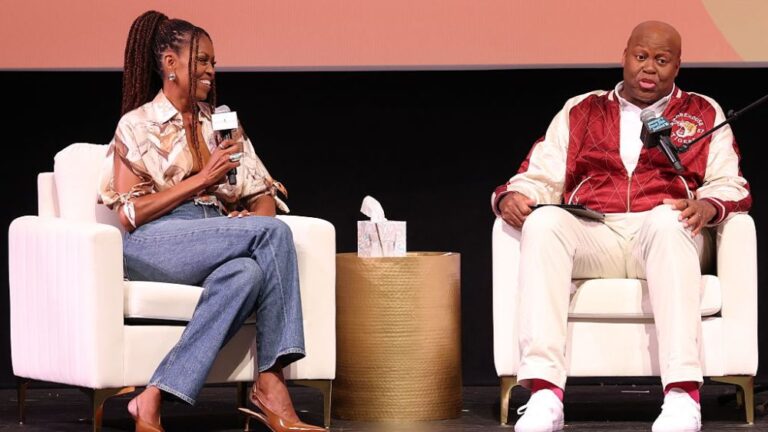
Michelle Obama and Natasha Rothwell recently shared the stage to discuss pivotal themes of identity, community, and storytelling. During a live taping of “IMO With Michelle Obama and Craig Robinson” at the Martha’s Vineyard African American Film Festival, they delved into Rothwell’s dynamic career, upcoming projects, and the importance of being seen in the industry. This engaging dialogue highlighted Rothwell’s journey and her creative path to success, bringing a wealth of inspiration to the audience.
Natasha Rothwell’s Unique Career Path
At the festival, Rothwell recounted her unexpected journey into Hollywood. “I had no aspirations for Hollywood,” she shared with Michelle Obama, reflecting on her initial ambitions to become a Broadway actor. Despite studying acting in college, Rothwell also embraced writing, which played a significant role in her artistic evolution. She recalled her early days performing improv in New York City and teaching acting in Japan, admitting she never anticipated fame. Her passion lay in collaborative efforts, which made stand-up comedy less appealing compared to improv and sketch.
From “SNL” to “Insecure”
Rothwell’s writing career advanced with her work on “Saturday Night Live,” where she was the only Black writer. Her transition from that structured environment to “Insecure” was transformative. Recalling her introduction to “Insecure,” she described the relaxed and open nature of the writing process there, where she felt truly seen and valued. This supportive atmosphere eventually led to her unexpected role as Kelli, a character originally created on paper, which Rothwell embodies on screen.
Creating Stories with Impact
The success of “Insecure” paved the way for Rothwell to explore new projects, such as her Hulu series, “How to Die Alone.” This venture allowed her to offer a personal narrative and create complex, resilient characters. The series, although short-lived, resonated with viewers and showcased Rothwell’s ability to bring meaningful representation to the screen. Her dedication to storytelling continues with “Who TF Did I Marry?,” an adaptation of Tareasa Johnson’s viral TikTok story. Despite the competitive bidding for rights, Rothwell’s Big Hattie Productions secured the project, emphasizing her commitment to uplifting marginalized voices.
The Power of Community
Throughout her conversation with Obama and Robinson, Rothwell underscored the importance of community in her career. Reflecting on her early days in New York, she highlighted the power of shared experiences and mutual support among peers. Rothwell’s journey exemplifies how betting on oneself, coupled with strong communal ties, can provide a solid foundation for creative growth and success.