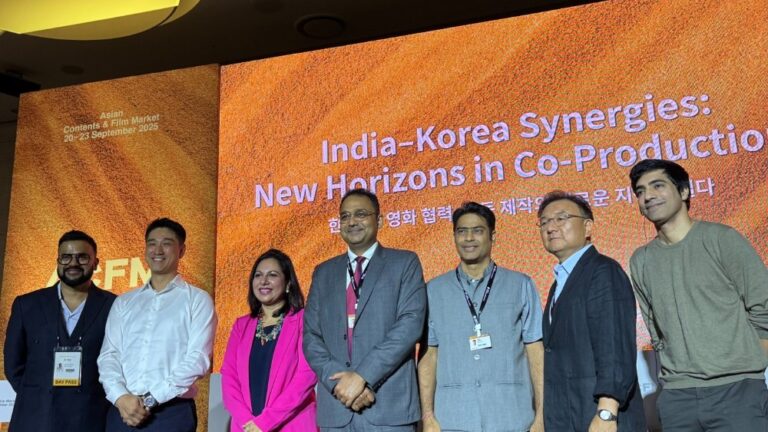
The recent spotlight on India-Korea co-productions at the Busan Asian Contents & Film Market underscores a burgeoning alliance between the two countries’ film industries. Under the spotlight of the “India-Korea Synergies: New Horizons in Co-Productions” panel, a blend of policymakers, producers, and media personalities delved into strategies for strengthening these cross-cultural ties. This collaboration not only promises a fusion of storytelling traditions but also opens up new markets and opportunities for innovation in cinema.
Forging Stronger India-Korea Relations
At the heart of the event was a panel featuring key figures like Prithul Kumar from India’s Ministry of Information and Broadcasting and Korean industry leaders. The discussion revolved around enhancing cooperation and mutual benefits in India-Korea co-productions. Prithul Kumar elaborated on India’s incentive framework, which offers substantial rebates for international productions—a considerable draw for Korean filmmakers. “Our co-production agreements mean films can qualify as national films in both countries, opening markets and maximizing support,” he emphasized.
Highlighting Collaborative Success Stories
Anthology Studios president Choi Jae-won celebrated his company’s remake of the Indian blockbuster “Drishyam” as a significant achievement for India-Korea co-productions. He described it as “a landmark step in bridging storytelling traditions.” Similarly, LME Studios CEO Heo Youngkook shared insights into his collaboration on the 3D animation “Astro Station,” praising India’s advanced VFX capabilities.
The Creative Superpower
Arfi Lamba, an actor-producer, remarked on the robust potential of Asia’s creative industries as a collective force. “This is the time to take the front foot, go global together, and recover faster through shared resources,” he said, stressing the importance of India-Korea co-productions. Lamba highlighted India’s extensive experience in providing VFX services to global giants like Disney and Marvel.
Challenging Stereotypes and Building Bridges
Media personality Abhishek Gupta, based in Seoul, pointed out the need to reshape Korean perceptions of Indian cinema beyond the traditional song-and-dance numbers. “Korean audiences still think of Indian films as just song-and-dance epics, but younger viewers are ready for action-driven, layered stories,” he noted. Nishikant Singh, deputy chief of mission at the Embassy of India in Seoul, echoed this, advocating for increased festival participation and talent exchanges to strengthen the influence of India-Korea co-productions.
The panelists collectively recognized the potential of India-Korea stories to captivate audiences not just across Asia but globally, heralding a promising future for collaborative cinematic ventures.