Hollywood’s storied battle with Washington, D.C. over freedom of expression is a compelling chapter in American history. At the heart of this struggle was the Hollywood Ten, a group that became emblematic of the fight against government censorship. This conflict erupted during the McCarthy era, spotlighting the tension between creative freedom and political scrutiny.
The Birth of the Committee for the First Amendment
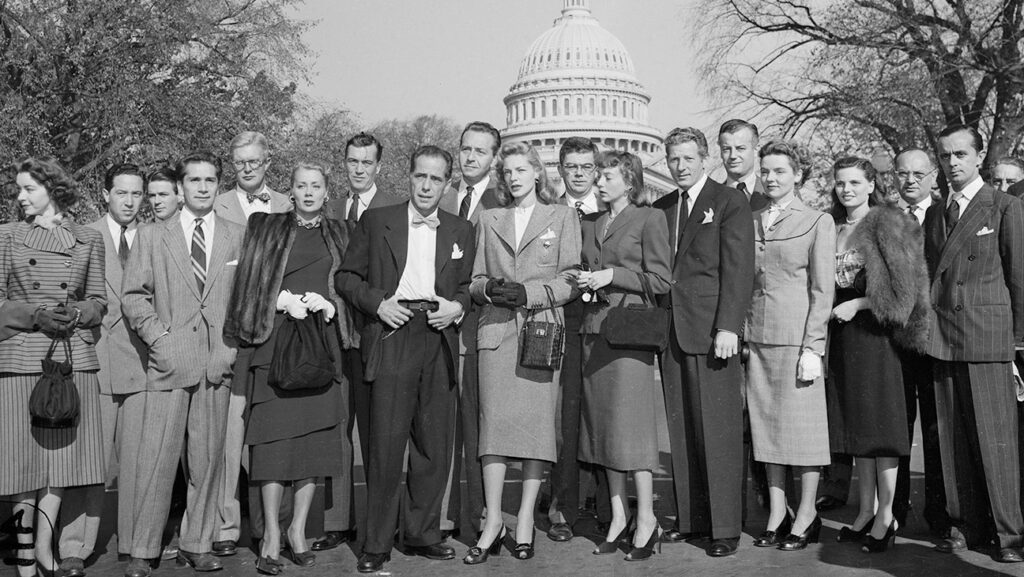
In response to the Red Scare, the Committee for the First Amendment (CFA) was born in September 1947. Founded by screenwriter Philip Dunne, actress Myrna Loy, and filmmakers John Huston and William Wyler, the group championed Hollywood’s freedom of expression. Its mission was to support the Hollywood Ten, a group of creatives who faced contempt charges after refusing to testify about alleged communist ties before the House Un-American Activities Committee (HUAC).
Hollywood’s Heavyweights Rally
The CFA rapidly gained support from industry icons such as Humphrey Bogart, Katharine Hepburn, Lauren Bacall, Frank Sinatra, and Judy Garland. Their campaign included placing ads in The Hollywood Reporter, outlining a nonpartisan agenda to challenge HUAC’s proceedings. On October 27, the CFA aired “Hollywood Fights Back,” its first radio broadcast critiquing the HUAC hearings. However, as industry blacklisting intensified, figures such as Bogart and Bacall gradually distanced themselves from the group, leading to its eventual dissolution.
Revival Amidst Modern Concerns
Recently, Oscar winner and activist Jane Fonda, daughter of original member Henry Fonda, reignited the Committee with over 500 Hollywood allies, including Jamie Lee Curtis, Ben Stiller, Viola Davis, and Billie Eilish. This resurgence was underway before ABC temporarily suspended Jimmy Kimmel Live! due to FCC chair Brendan Carr’s criticism, highlighting the ongoing necessity to defend creative freedoms.
Comedian and Committee member Audra Sisak remarked, “Kimmel was the last straw, and we definitely needed to get our rights back.” With Fonda at the helm, the CFA has initiated virtual gatherings, encouraging participation in events like the “No Kings” protests on October 18.
The Entertainment Industry’s Role
“Now, just like back then, the entertainment industry — which depends on free expression — has a special responsibility to help lead the charge,” Fonda emphasizes. “Every act of censorship paves the way for the next — unless we stand up, loudly and collectively, to stop it.”
This story appeared in the October 22 issue of The Hollywood Reporter magazine. Click here to subscribe.