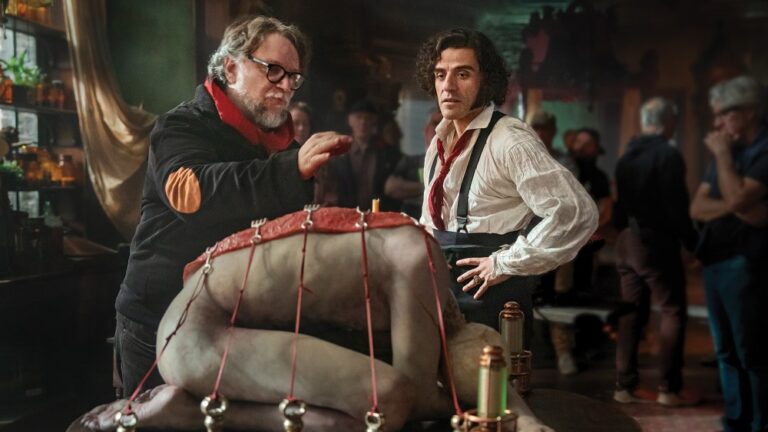
Guillermo del Toro explores the nuances of humanity through his creative lens in “Frankenstein,” where brutality and grace coexist. Known for his distinctive storytelling, del Toro’s latest film delves into the complexity of being human, drawing on his deep understanding of monsters and misfits. This piece explores how del Toro balances these elements in his adaptation of Mary Shelley’s classic, offering a fresh perspective on a timeless story.
Guillermo del Toro has carved a niche in cinema with his unique portrayal of monsters, not merely as creatures of fear but as symbols of misunderstood humanity. The visionary director, known for “The Shape of Water” and “Pan’s Labyrinth,” returns to his roots with an adaption of “Frankenstein,” which he describes as not just a monster movie, but an exploration of human existence.
“To me, the point of origin was ‘Frankenstein,’” del Toro shared with Variety. “This is not a monster movie. This is a story about what it means to be human.”
Del Toro’s rendition of the 1818 classic is a departure from conventional horror, weaving myth, metaphor, and opera into a rich tapestry. After years in the making, “Frankenstein” debuted at the Venice Film Festival, capturing audiences with its profound storytelling and elaborate visuals. With screenings at Toronto following its sold-out appearances in Telluride, del Toro’s vision is set to captivate North American audiences.
The Heart of “Frankenstein”
Oscar Isaac takes on the role of Dr. Viktor Frankenstein, while Jacob Elordi transforms into the Creature, supported by Christoph Waltz and Mia Goth in mysterious roles. Del Toro describes the film as a “gothic rock concert about loneliness,” where love, grief, and rage intermingle.
Del Toro praises Elordi’s portrayal of the Creature, highlighting its childlike wonder: “He’s discovering the world moment to moment.” The director appreciates Elordi’s “balletic grace,” which melds beauty with terror, underscoring the film’s emotional depth.
While Elordi’s Creature is central to the narrative, Isaac’s portrayal of Viktor adds intensity and complexity. “He brings this fury, this guilt, this madness,” del Toro notes, emphasizing Isaac’s dynamic range and the heartbeat he provides to the film.
The Journey to Creation
Del Toro’s long-standing ambition to adapt “Frankenstein” reflects his enduring fascination with the creature. “I’ve been following the creature since I was a kid,” he reveals. “I waited for the movie to be done in the right conditions.”
Every aspect of the film bears del Toro’s signature — from intricately designed sets to Alexandre Desplat’s haunting score. Its blend of brutality and grace is already attracting award buzz, as del Toro articulates: “This movie doesn’t pull its punches. But there’s also grace. And maybe that’s the point — that both can exist in the same body.”
A Collaborative Spirit
The reception to “Frankenstein” has been mixed, with an 81% Rotten Tomatoes score echoing past reactions to del Toro’s work. Nonetheless, Netflix is positioning it for award consideration, alongside other potential contenders.
Embracing both success and setbacks, del Toro maintains a positive outlook. “I’ve written 30 scripts and made 13 movies,” he states. “When a movie doesn’t move forward, I tell my team, ‘It was good practice.’”
His commitment to the filmmaking community is evident in his willingness to support emerging talent. “If [young filmmakers] need three days from me to watch their movie and give feedback, I’ll give it to them,” he says. Every Sunday, he hosts gatherings for painting and camaraderie, emphasizing the importance of community in sustaining creativity.
“Frankenstein” tells the poignant tale of a being created only to be cast aside, fueled by anger over its abandonment yet marveling at a world offering scarce love. Through del Toro’s lens, monsters emerge not as threats, but as souls striving for acceptance.
Much like the Amphibian Man in “The Shape of Water,” or the ghostly figures in “The Devil’s Backbone,” the Creature in “Frankenstein” is a symbol of tragedy and beauty — a testament to del Toro’s belief in the duality of existence.
“Frankenstein” makes its North American premiere at the Toronto Film Festival on Monday, Sept. 8.