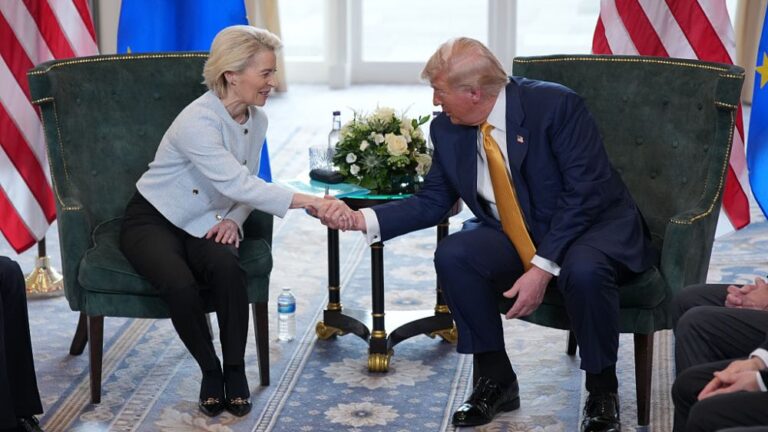
In a move that has sparked intense debate, the European Union (EU) and the United States have finalized a trade agreement, described as a political coup for U.S. President Donald Trump and a challenging day for Europe. This deal, setting a 15% U.S. tariff on goods from the EU’s 27 member states, has been met with mixed reactions, highlighting its complex implications for international trade dynamics.
Negotiation Outcomes and Political Reactions
After prolonged and tense negotiations, U.S. President Donald Trump and European Commission President Ursula von der Leyen announced the trade agreement, which imposes a 15% tariff on most EU imports. While this is notably lower than Trump’s previous 30% threat, it still signifies a significant increase from the former 4.8% rate. French Prime Minister Francois Bayrou expressed strong disapproval, declaring it “a dark day” for European unity and independence.
European Media and Political Interpretations
The new trade deal is largely seen by European media as a setback for the EU and a strategic victory for Trump. Despite European concerns, the EU avoided immediate retaliatory measures such as a digital service tax on U.S. streamers like Netflix. The agreement also commits the EU to substantial purchases of American oil and gas, totaling $750 billion over three years, as reported by France 24.
Support and Skepticism Across Europe
Despite some opposition, Ursula von der Leyen has praised the agreement for promoting stability between the two trade giants, who collectively represent a significant share of global commerce. Italian Prime Minister Giorgia Meloni viewed the deal positively, aligning with von der Leyen’s sentiments, although Italian business communities remain cautious about its impact.
Varied Economic Implications
French criticism has been particularly vocal, with officials like European Affairs Minister Benjamin Haddad labeling the deal as “unbalanced.” In France, where industries such as luxury goods heavily rely on the U.S. market, the deal’s terms have spurred concerns. Haddad suggested leverage through EU’s power over U.S. digital services in future talks, advocating for measures to address the imbalance.
The transatlantic trade deal has therefore ushered in a period of complex economic interactions and political maneuverings, as Europe grapples with its terms and future diplomatic strategies.