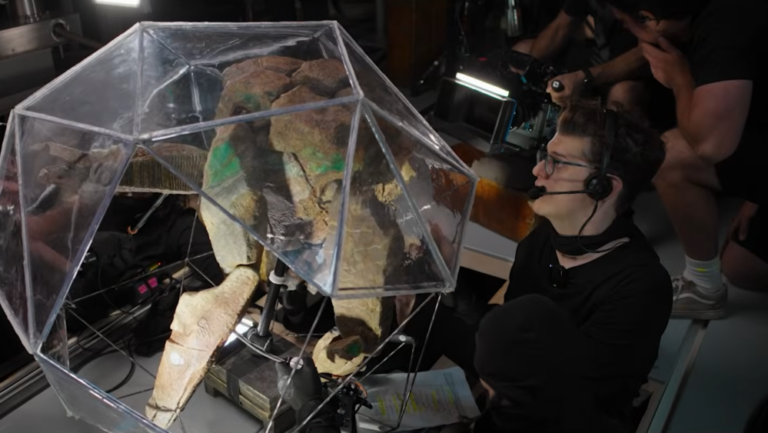
In the captivating transformation of Andy Weir’s bestseller ‘Project Hail Mary’ into a cinematic experience, the creation of the lovable alien Rocky stands out. Brought to life by the ingenious puppeteer James Ortiz, Rocky becomes more than just a sci-fi creature through practical effects and an immersive performance alongside Ryan Gosling. This behind-the-scenes glimpse reveals how Ortiz transformed the character into a standout personality, contributing significantly to the film’s appeal.
Bringing Rocky to Life
When Ryan Gosling interacted with his alien counterpart in ‘Project Hail Mary’, it wasn’t alongside a typical green screen effect. Instead, he engaged with an intricate puppet brought to life by James Ortiz, who is renowned for his work with animals and fantastical creatures on Broadway. Ortiz dedicated nearly six months to the film’s production in London, under the direction of Phil Lord and Christopher Miller, who prioritized practical over digital effects to capture authenticity.
“Actor to actor, I didn’t want Ryan to ever feel like he was alone in this,” Ortiz shares. “It would be too hard. I mean, he shouldn’t have to make character decisions for a strange, faceless creature.”
The duo rehearsed extensively to ensure seamless blocking, allowing Gosling to connect genuinely with Rocky before the puppet was introduced. “That would be our one chance to check in with each other, see each other’s eyes, and sort of figure out the beats,” says Ortiz.
Crafting Personality Without a Face
Rocky, the spider-like alien with a unique way of communication and a peculiar appearance, quickly becomes a beloved figure in the film. The challenge for Ortiz and designer Neil Scanlan was to instill charisma into a puppet lacking typical expressions. “Rocky is super intelligent and has a mind like a computer,” Ortiz explains. “But his soul, to me, always felt like that of a little brother. There’s a little bit of this anxious, 14-year-old boy who really wants to be invited to the party.”
Scanlan encouraged Ortiz to make the puppet his own. “I’m going to treat this like you’re Frank Oz, and my job is to build Yoda for you,” he emphasized, highlighting the creative freedom Ortiz was given.
From Craft to Screen
The pre-production phase was crucial, with Ortiz involved in the puppet’s design to optimize its operation. The ‘Project Hail Mary’ set was tailored to accommodate Ortiz and the puppeteering team, with structures built above ground level for operational convenience. For scenes requiring complex movements, animatronics and CGI were employed. “Puppeteering rolling in a ball through a ship would be pretty impossible to pull off,” Ortiz notes, elucidating the need for digital interventions.
Despite language barriers, Rocky communicates with Gosling’s character thanks to a translation system. On set, Ortiz provided voice cues from a booth, contributing to the actor’s performance. “Rocky’s voice comes out of a series of computers that have been sort of duct-taped together,” Ortiz says, aiming for an authentic but imperfect sound.
To Ortiz’s surprise, the directors opted to retain his original voice tracks, recognizing the authenticity he brought to the character. “Getting that call was incredible,” Ortiz recalls. “I’d convinced myself it wouldn’t be me.”
A Collaborative Effort
The production navigated numerous technical challenges, yet Ortiz appreciated the inclusive atmosphere fostered by Lord and Miller. “What I loved about the process was at no point did Phil or Chris or anybody on the team ever treat me like I was a technician, or like a plumber who was brought in to fix a specific thing,” he remarks. His input was valued in shaping Rocky’s on-screen persona, adding depth to the character.
This collaborative spirit and emphasis on practical effects are essential to Rocky’s endearing presence, making ‘Project Hail Mary’ more than just a visual spectacle—it’s a heartfelt narrative driven by creativity and connection.