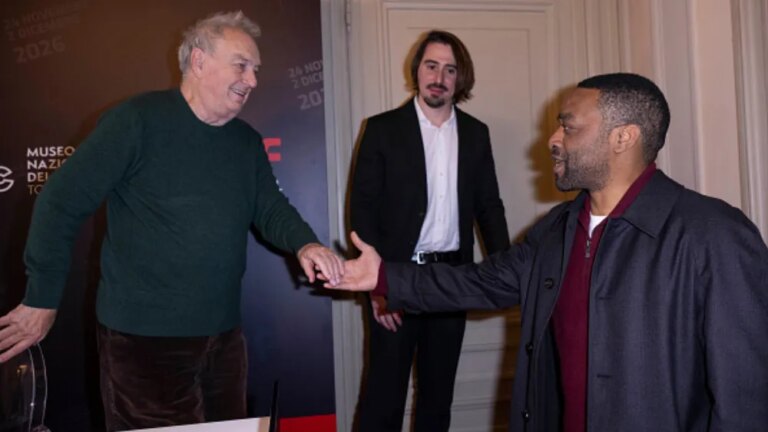
Chiwetel Ejiofor, renowned for his remarkable versatility as an actor, reflects on the beginnings of his cinematic journey, which kicked off in style with a collaboration with none other than Steven Spielberg in the film “Amistad.” This debut experience, while exhilarating, left him concerned about the potential of peaking too soon in his career.
Facing Initial Fears
Speaking at the Torino Film Festival, Ejiofor openly shared, “I was definitely worried about it at the time.” He emphasized the unpredictable nature of an acting career, noting that while opportunities may seem expected to follow a linear progression, they often arise in surprising ways. “You realize then, very early on, that it’s a deeply unpredictable profession,” he explained.
Ejiofor highlighted the dilemma that actors face: the possibility of feeling anxious about their career paths or choosing to embrace the uncertainty. “The opportunities can be sporadic or come from different places and angles that you didn’t imagine,” he said, acknowledging that part of the allure of acting is the journey itself and the unexpected destinations it leads to.
Acknowledging His Roots
Recently honored with the Stella della Mole award for lifetime achievement in Italy, Ejiofor reminisced about his initial self-perception as a primarily theater actor, despite his early achievement in film. “Even though I had done the Steven Spielberg film, I still thought of myself primarily as a theater actor,” he noted, recalling his extensive work with the National Theatre in Great Britain and various Off-West End companies. His talent was recognized in 2008 when he won the Laurence Olivier Award for his performance in “Othello.”
Transformative Experiences in Film
It was Stephen Frears’ critically acclaimed thriller “Dirty Pretty Things” that profoundly shifted Ejiofor’s perspective on acting, solidifying his passion for film. This film was showcased at the Torino Film Festival, which also honored Frears with an award. “I think it was around that time when I started to fall in love with film as well, with film acting and the rhythm and poetry of cinema,” he admitted. His newfound admiration was significantly influenced by both Frears and cinematographer Chris Menges, marking a pivotal moment in his career.
For some time, Ejiofor successfully balanced his endeavors in both theater and film. However, as he began directing and writing, he found those pursuits consuming more of his time. “Historically, this would have been the time I spent on stage,” he recounted, indicating the shift of his focus from live performances to filmmaking.
Returning to the Stage
Ejiofor, who has directed two feature films—“Rob Peace” and “The Boy Who Harnessed the Wind”—expressed his eagerness to return to theater. “It’s still something that I’m very passionate about. Finding the time to do as much theater as I want can be challenging, but it’s something I’m in the midst of conversations about,” he stated, revealing his plans to potentially engage in a theater production next year.
Reflecting on Career Highlights
As he looks back on his significant career moments, Ejiofor fondly recalls his role in the Oscar-winning film “12 Years a Slave,” directed by Steve McQueen, which was also featured at the festival. In this powerful film, he portrayed Solomon Northup, a free black man kidnapped and sold into slavery in 1841. “I hadn’t heard of his story at all. When I was sent the script, I was incredibly moved and shocked by it,” he reflected, praising the narrative that encapsulated a tragic period marked by a “very tragic period of absence of humanity.”
He expressed a deep emotional connection to the material, noting, “It felt very profound to me. I was just deeply moved.” In his acknowledgment of McQueen’s filmmaking prowess, Ejiofor described him as “a phenomenal filmmaker, incredibly passionate, detailed and thorough, with a wonderful vision and cinematic heart.” He concluded by appreciating the global reception of the film and its recognition by the Academy, underscoring its core message of human respect and dignity.