Renowned filmmaker Roland Sejko has delved deep into the world of Enver Hoxha-era propaganda with his documentary, “A State Film.” This captivating work, crafted from Albania’s Soviet-tinged propaganda archives, reveals a remarkable passion for the cinematic. Sejko’s exploration brings to light the intricate use of imagery to construct and disseminate political narratives, offering viewers a fresh perspective on the power of film in shaping ideology.
The Cinematic Power of Propaganda
Sejko’s documentary was a highlight at the Ji.hlava International Documentary Film Festival, known for showcasing thought-provoking nonfiction work. “A State Film” compels audiences to unpack the cleverly constructed imagery designed to influence the masses, showcasing Albania’s Soviet-tinged propaganda archives in an entirely new light.
“I’ve been working for several years with propaganda film archives — first with Istituto Luce Cinecitta, and also with the archives of the Albanian communist regime,” Sejko explains. These archives, which include thousands of films, are not just visual documentation but powerful narratives crafted with cinematic ambition.
From Archive to Art
Having previously explored similar themes in “The Image Machine of Alfredo C.,” Sejko is well-versed in the intricacies of propaganda. His earlier film depicted the story of an Istituto Luce cameraman involved in Mussolini and fascist propaganda, showcasing the journey of Albania’s cinematic history with depth and understanding.
Sejko’s role as an archivist at Cinecitta Luce enabled him to meticulously curate decades of footage, allowing these compelling narratives to unfold. “The Albanian propaganda newsreels and documentaries clearly bear the mark of Eastern Bloc cinematography,” Sejko notes, highlighting their Soviet-tinged influence.
Unveiling the Layers of Influence
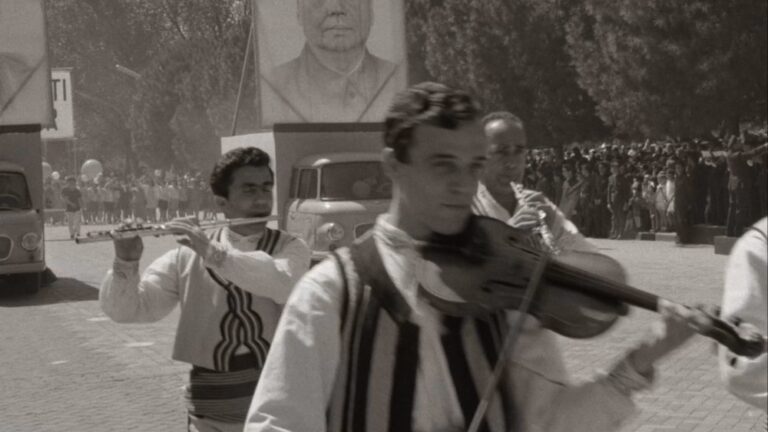
In “A State Film,” the striking similarity between propaganda filmed across the Eastern Bloc is evident. Footage of parades and celebrations mirrored those from Moscow or Sofia, indicating a shared methodology driven by a singular vision. Sejko says, “It is not just the cameraman’s technique that creates this resemblance; it is the vision of the world being shown.”
Sejko’s approach involved more than just visual storytelling. By removing the original prescriptive narration and replacing it with ambient sounds, he crafted a new soundscape that allows viewers to engage with the material in an authentic way. This method restores the images’ physicality, creating a narrative where sound itself becomes an interpretative tool.
A Thought-Provoking Reflection on Power
The documentary’s intercutting of footage from Hoxha’s personal archive adds depth, revealing the isolation and loneliness that often accompanied power. These moments serve as poignant symbols within Albania’s Soviet-tinged propaganda archives, inviting viewers to reflect on how propaganda has evolved over time and how its classic elements persist today.
“A State Film” transcends national history, inviting us to consider the enduring function of imagery in politics and its profound ability to shape collective memory. Through the lens of Roland Sejko, Albania’s cinematic past emerges as a rich tapestry, woven from the threads of propaganda and power, prompting a fresh examination of history’s visual narrative tools.