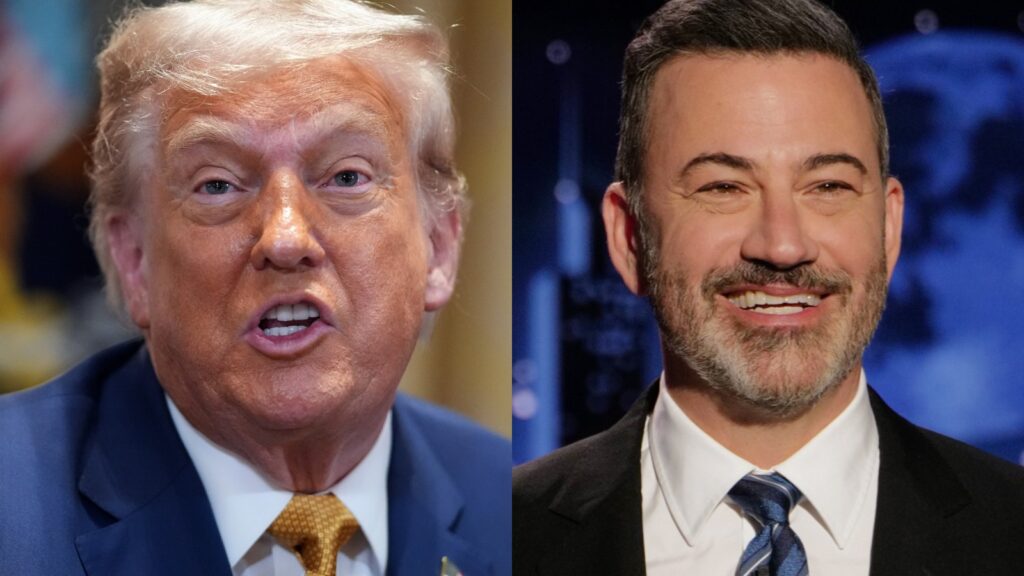
In a surprising turn of events, former President Donald Trump openly celebrated the suspension of Jimmy Kimmel’s late-night show, claiming it as “Great News for America.” The announcement came after ABC removed the show indefinitely, following Kimmel’s controversial remarks about the assassination of political commentator Charlie Kirk. Trump’s reaction has stirred a broad spectrum of opinions, shining a light on the often-colliding worlds of politics and entertainment.
Trump Applauds ABC’s Decision
Donald Trump took to Truth Social to express his approval of ABC’s decision to pull Jimmy Kimmel from the airwaves. Describing the suspension as “Great News for America,” Trump praised the network for having the “courage to do what had to be done.” He further criticized Kimmel, describing him as lacking talent and having worse ratings than Stephen Colbert, another late-night host whose show was canceled earlier this summer. Trump did not stop there; he also took digs at Jimmy Fallon and Seth Meyers, labeling them as “two total losers” on what he referred to as “Fake News NBC.”
Kimmel’s Controversial Comments
The suspension came after Kimmel’s monologue on Monday night, where he accused right-wing figures of trying to exploit Kirk’s killing for political gain. Kimmel’s words stirred controversy, particularly among conservatives, who took issue with the host’s implications regarding the shooter’s affiliations. Despite Fox News interpreting Kimmel’s comments as linking the shooter to the “MAGA gang,” Kimmel did not explicitly make such a claim.
ABC’s Response and Industry Reactions
By the middle of the week, ABC confirmed to Rolling Stone that “Jimmy Kimmel Live” would be pre-empted indefinitely. This move followed swift action by Nexstar to remove his show from its U.S. stations. Amidst this backlash, Brendan Carr, Trump’s appointed FCC chairman, urged licensed broadcasters to reconsider airing Kimmel’s content, citing potential risks of fines or license revocation due to perceived news distortion.
A Larger Debate on Media and Politics
The suspension of Kimmel’s show has sparked a broader debate about the role of media in political discourse. Carr emphasized the need for broadcasters to demand accountability from networks like Comcast and Disney regarding content that could skew public perception. “We can do this the easy way or the hard way,” Carr warned, indicating potential FCC interventions should broadcasters fail to address these issues.
This episode underscores the ongoing tension within the landscape of media and politics, where the boundaries between entertainment and political commentary continue to blur. As figures like Trump remain vocal about their perspectives, the conversation about media responsibility and freedom of expression remains ever relevant.