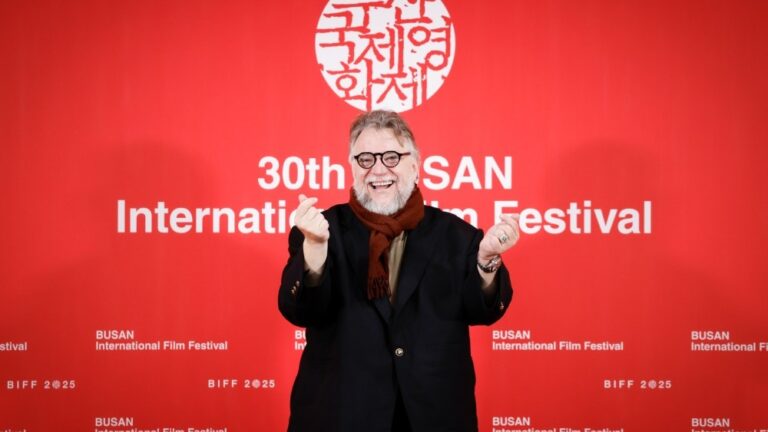
At the Busan International Film Festival, acclaimed filmmaker Guillermo del Toro celebrated the vibrant world of Korean cinema, highlighting his deep connection with renowned directors Bong Joon Ho and Park Chan-wook. Del Toro shared insights into how their films resonate with his own cinematic approach, especially in relation to his upcoming film, “Frankenstein.” His reflections emphasized a shared commitment to cultural authenticity over commercial formulas.
Del Toro’s Admiration for Bong Joon Ho
Guillermo del Toro expressed profound admiration for Bong Joon Ho, acknowledging a “great kinship” between their creative processes. Del Toro praised Bong’s films, particularly “Memories of Murder,” as beautifully complex works that merge chaos with poetry. “It’s not an American procedural about a crime — it’s an existential, deep meditation and an imperfect investigation by imperfect police that themselves are corrupt,” del Toro noted, appreciating the unique voice that Korean cinema embodies.
Del Toro also highlighted “The Host” for its impactful monster designs, which serve as a medium to explore Korean society and family dynamics. “He uses it to talk about the society of Korea and the family life of Korea. So he’s talking about specifically the culture, which is what I do,” he elaborated.
A Deep Connection with Park Chan-wook
In particular, del Toro’s praise for Park Chan-wook was profound, citing Park as a “twin soul.” Del Toro described him as “one of the most beautiful, desperate, existential romantics in cinema.” He emphasized how Park’s work embodies a rare romanticism, delving into the darker aspects of human experience. “He’s a twin soul in that sense,” del Toro said, finding a shared artistic spirit.
Del Toro highlighted how Korean filmmakers prioritize cultural authenticity over commercial tendencies. “There is a position about the genre that doesn’t make them commercial for an American market. They make them unique to Korea,” he remarked, adding that Korean films invigorate him, making him feel “a little more alive.”
Cinematic Parallels and Cultural Exploration
Del Toro commented on the shared thematic elements between his work and Korean cinema, particularly in how both use genre to explore cultural identities. “When they say, ‘What is Mexican about your movies?’ Me, I’m very Mexican, and my movies have that same slant,” he explained.
Discussing his adaptation of “Frankenstein,” del Toro described it as autobiographical, reflecting his own cultural perspective. The film, viewed through his “60-year-old Catholic Mexican perspective,” contrasts with Mary Shelley’s original narrative. Del Toro believes the themes of forgiveness and imperfection are incredibly pertinent today, especially in a world polarized by absolute views.
“We live in a time where we have polarized everything into completely good or completely bad, and there’s no oxygen for humanity in those two sides,” del Toro reflected. “We all exist in the middle.”