Danny Boyle’s latest film, “Ink,” provides a gripping portrayal of Rupert Murdoch’s ascent within the dynamic world of London’s Fleet Street, particularly focusing on the transformative takeover of The Sun newspaper. Based on the Tony-nominated play by James Graham, the film offers a fresh cinematic perspective as Graham himself adapted his stage work for the screen. The film stars Guy Pearce as the ambitious Murdoch and Jack O’Connell as Larry Lamb, the working-class editor who played a key role in reinventing The Sun into a popular powerhouse.
Set against the backdrop of 1969 London, “Ink” is set to premiere at the London Film Festival before its theatrical release on December 11. It will subsequently be available on Netflix in the U.S. and Latin America starting January 8.
Bringing 1969 to Life
Boyle enlisted his acclaimed production designers, Gareth Pugh and Carson McColl, to vividly recreate the essence of Fleet Street during a time when sensationalist journalism began to flourish. “He wanted to reset the expectations of a period film,” McColl explains, aiming for a look that was both immediate and engaging. This intent mirrored the period’s unique approach to journalism, especially with The Sun’s notorious use of clickbait-style headlines.
Today’s Fleet Street stands in stark contrast to its 1969 counterpart, as much of its historical architecture has been replaced by modern buildings. The original headquarters of The Sun, situated on Bouverie Street, posed challenges in recreating the newsroom’s authenticity. Ultimately, the production team secured a suitable location in Bromley, U.K., transforming a vacated council space that offered diverse architectural elements necessary for the film’s set pieces.
The Nerve Center of the Film
The newsroom, described as the “nerve center” of the film, was a major focus for Pugh and McColl. Boyle likened it to a spaceship, emphasizing its significance in the narrative. The two designers collaborated with consultants who experienced Fleet Street in 1969 to authentically map out the newsroom’s layout, ensuring it captured the frenetic energy and daily operations of a bustling newsroom. “It was amazing to see how it resembled an ecosystem,” McColl noted, highlighting the intricate choreography of human traffic as the day progressed toward copy deadlines.
Working under a limited budget required creativity and resourcefulness. According to McColl, “Danny gives us a lot of latitude when we’re designing sets,” which allowed them to add authenticity by incorporating elements like cigarette smoke and vintage equipment. “We smoked like two packets of cigarettes, so that it smelled like cigarette smoke,” McColl remarked, demonstrating their commitment to immersing the cast in the era.
Reviving Vintage Technology
A significant challenge was locating functional Linotype machines essential for The Sun’s typesetting process. McColl explained, “They’re priceless. There are very, very few left in the world.” Fortunately, set decorator Ben Barrington Groves connected with a passionate individual in hot metal printing, leading to the acquisition of three operational Linotype machines for the production.
Detailing Larry Lamb’s Office
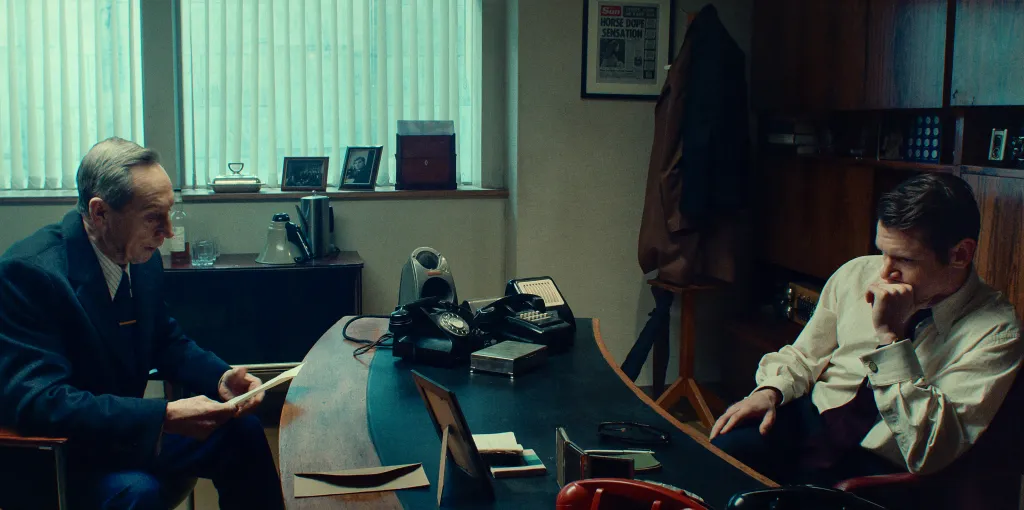
The design of Larry Lamb’s office served to reflect his narrative arc throughout the film. McColl elaborated, “The newsroom was supposed to look tired — functional, but reflective of a struggling newspaper.” As the plot unfolds, Lamb’s character becomes increasingly isolated, emphasized visually through the office’s design and the use of gridded glass windows. This intentional framing suggests that while he achieved his goals, he ultimately found himself alone.
Collaboration with set decorator Alice Davies proved invaluable, leading to a perfect layout for Lamb’s office. The detail extended to functional props, including a phone that provided real sales numbers, enhancing the authenticity of the environment.
Challenges of Film Production
In a notable sequence, Murdoch is depicted riding the London Underground, where modern upgrades complicated the filming process. “There’s only one train of the right era, located near Watford,” Pugh said, referring to a historic museum train. The production team’s ingenuity turned this obstacle into an opportunity, using high-powered wind machines and flying newspapers to simulate the hectic atmosphere.
Lighting designer Steve Mackie employed fast-moving bar lights to make the underground train appear to speed along. The team’s DIY spirit came through during preparations as they experimented with setups, and Boyle utilized a 360-degree camera for key sequences, including the pivotal kidnapping of Muriel Mackay, resulting in dynamic visuals that paid off creatively.
Courtesy of Studiocanal