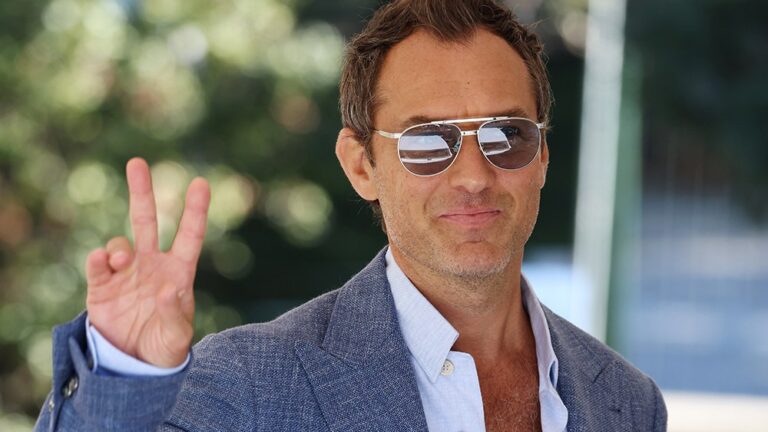
Jude Law embraces the complexity of embodying Vladimir Putin in the much-anticipated political thriller, “The Wizard of the Kremlin,” which is set to premiere at the Venice Film Festival. The film, helmed by Olivier Assayas, chronicles Putin’s rise amid the tumultuous post-Soviet era. Law stands firm, asserting that his portrayal isn’t meant to court controversy but to tell an intricate and thoughtful story. The film’s relevance is magnified against the backdrop of today’s geopolitical climate, making it a compelling narrative for audiences worldwide.
Confident in Artistic Direction
Jude Law expressed his confidence in Olivier Assayas and the script, emphasizing a portrayal that is both nuanced and considerate. “I didn’t fear repercussions. We weren’t looking for controversy for controversy’s sake,” Law stated. He underscored that his role as Putin fits within a broader narrative, rather than an attempt to define the Russian leader.
The Intriguing Adaptation
Based on Giuliano da Empoli’s gripping bestseller, “The Wizard of the Kremlin” delves into the fictional ascent of Putin, weaving in his association with the enigmatic spin doctor Vadim Baranov, portrayed by Paul Dano. Baranov, inspired by the real-life figure Vladislav Surkov, plays a critical role in shaping Putin’s autocratic persona. Fellow stars Alicia Vikander, Tom Sturridge, and Jeffrey Wright join the ensemble cast, adding depth to this complex story.
A Unique Creative Approach
Law intentionally crafted a distinct portrayal, opting to alter his physical appearance while maintaining his natural voice. “This wasn’t to be an interpretation of Putin,” he explained. “We tried to find a familiarity on me. It’s amazing what a great wig can do.” In contrast, Paul Dano focused on internal motivations to explore his character Baranov, avoiding oversimplification.
A Cautionary Tale for Modern Politics
Director Olivier Assayas frames “The Wizard of the Kremlin” as more than just an origin story of Putin. It’s a reflection on the evolution of modern politics and the rise of authoritarian figures globally. “We made a movie about what politics has become and the dangerous situation we all feel we’re in,” Assayas commented, highlighting the broader implications of the narrative.
As geopolitical tensions continue, especially with Russia’s involvement in Ukraine, Jeffrey Wright noted the film’s global significance. “This film is about a specific place but it has global implications,” Wright remarked, emphasizing the importance of examining political dynamics not just abroad but within America’s own historical context.
“The Wizard of the Kremlin” challenges viewers to consider the complexities of power and governance, making it a timely and thought-provoking experience for audiences around the world.