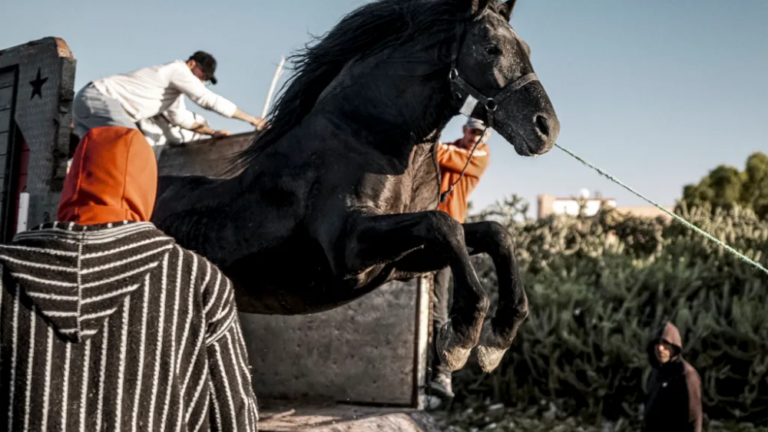
Tala Hadid, the director of the documentary “Bardi,” spent over four years immersing herself in Moroccan communities engaged in the traditional equestrian ritual of Tbourida. This centuries-old practice, rooted in historical warfare, showcases horsemen charging in formation while firing their rifles in synchronized unity. Despite her deep involvement, Hadid reflects that she feels she has only scratched the surface of the complexities surrounding this rich cultural landscape.
Exploring the Brotherhood and Relationship with Horses
“Bardi” captures the essence of a brotherhood of riders who come together for Tbourida. The film delves into the families supporting this tradition and highlights the profound bond between the young men and their horses. Hadid’s approach keeps the camera intimately close, focusing on how these men transition from their everyday lives into almost mythical figures astride their majestic animals.
Finding Beauty in Tradition
During an interview with Variety at the Doha Film Festival, where she presented the film after showcasing it at IDFA and Marrakech, Hadid reminisced about the moment she first encountered the riders and their impressive stallions. “It was so impressive,” she recalled. “I felt shocked by what I saw. Shocked not because it was something new but because it was such a beautifully sublime image that I felt the need to ask more questions.”
A Personal and Intimate Filmmaking Approach
As a photographer whose work has appeared in prestigious institutions like the Museum of Modern Art in New York, Hadid chose to lens the film herself. This decision allowed for a more agile production, as she followed the men throughout this extensive journey. “I started filming almost immediately,” she notes, emphasizing her preference for a small crew when working with real people.
Hadid elaborates on the importance of developing relationships with her subjects, describing the early interactions as a process where “there’s a very porous border between the camera and you as a person meeting people.” She explains that patience is essential in understanding the community, given the dynamic nature of the fraternity with 30 or 40 members often coming and going. “They were all very gracious and welcoming,” she adds.
Questions of Identity and Understanding
In responding to her motivations for capturing the Tbourida community, Hadid explains she did not aim to create a sociological or journalistic film. “I didn’t start thinking I would do a portrait of masculinity or deconstruct the masculine,” she clarifies. Instead, her desire was to gain a deeper understanding of the cultural significance of the ritual, intertwined with her own half-Moroccan heritage. This exploration sparked introspective questions about national identity: “Do we really know anyone or any community? How well do you know your country and your culture?”
This inquisitiveness allowed Hadid to address the mythology and beliefs entrenched in the horse-riding community with humility. She approached this unknown terrain as if she were “almost like an alien,” embracing the opportunity to truly observe. “Even now, four and a half years later and after a year of editing and finishing the film, I think I only know a little bit,” she reflects, illustrating her view that cinema inherently holds mysteries beyond the frame.
Blurring the Lines Between Fact and Fiction
Hadid’s understanding of cinema’s limits manifested in the film’s form, which navigates the boundaries between reality and imagination. “It was another threshold in the film, this fabulation of fictional elements,” she describes. “People start to change when there’s a camera. They perform, and I think of it as playing a game.” This exploration of performance only arose after developing intimacy with the subjects, introducing this playful element around three years into the filming process.
She emphasizes that the lines between documentary and fiction are blurred from the moment an image is edited, viewing the camera as a tool that captures transcendent moments. “There is no frontier; it is a no man’s land between the two,” she says. This perspective enables a transformative process for both the filmmaker and the subjects involved.
Creating Intensity Through Recreation
Hadid recalls re-staging a poignant moment in the film where a father explains to his daughter that she cannot ride alongside her brothers. “It is almost like doing therapy,” she says, as the intensity of the moment reveals deeper truths. “We were in a space where he had to tell his daughter once again that she couldn’t ride, and it was intense.”
Aiming to Awaken Audiences
“I am not saying ‘Bardi’ is revolutionary, but if you don’t shake people, if you don’t shake audiences and try to do something new, you will just make the same film again and again,” Hadid concludes. Her goal as an artist is to awaken the eye of the audience, prompting them to reconsider their perceptions. “Allow the image to work its power,” she emphasizes, aiming to transcend traditional binaries through her cinematic exploration.