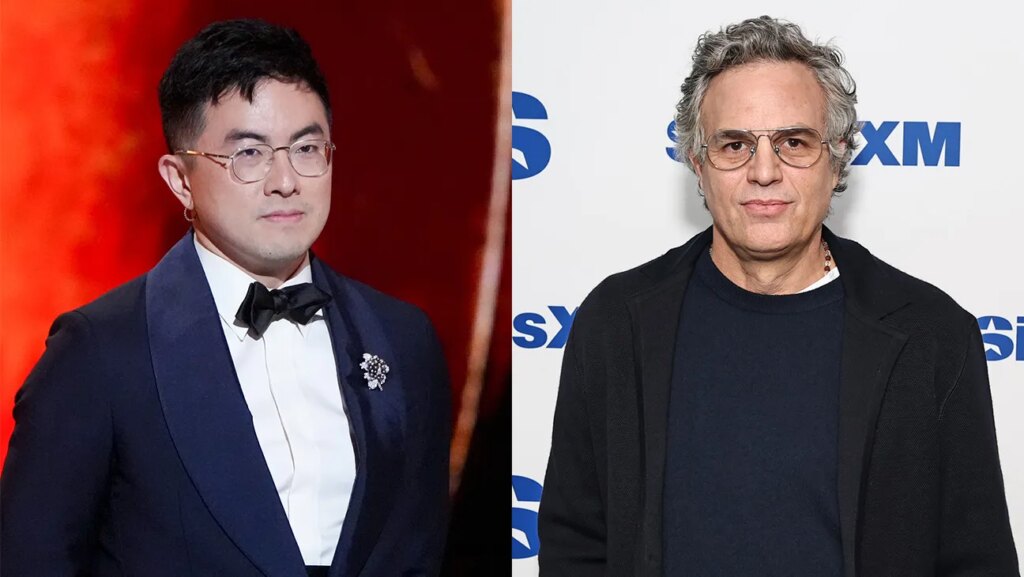
The recent resurfacing of a podcast clip featuring comedian Bowen Yang has reignited discussions about antisemitism in Hollywood and particularly among its progressive circles. Yang, a prominent figure in the entertainment industry, came under scrutiny for using the term “Zio” during an episode of Las Culturistas. The term, short for “Zionist,” carries a troubling antisemitic history, one that Yang claims he was not aware of at the time.
Bowen Yang’s Controversial Remarks
In the podcast, Yang’s remark followed a comment by guest Edy Modica, who described Jewish-American singer-songwriter Regina Spektor as “a little Israel, hard-core.” Spektor, known for her vocal support of Israel, particularly after the October 7 Hamas massacre, has poignantly addressed her experiences as a Jewish immigrant fleeing anti-Semitic persecution. Yang later expressed shock upon learning of the term’s origins, taking to Instagram to apologize: “I want to genuinely apologize for using a word on the podcast without knowing its antisemitic history,” he stated. “Particularly upsetting to realize that I adopted language popularized by far-right movements whose rhetoric we should be wary of and act against.”
A Cultural Context
The incident raises questions about Yang’s awareness of the complex relationship between contemporary left-wing ideology and antisemitism. In progressive spaces where Yang typically operates, racially charged terms, including those laden with historical prejudice, can often be disseminated without a full understanding of their implications. Observers may speculate on whether Yang truly comprehends the broader Israeli-Palestinian conflict or if he, like many in his social circles, absorbs a progressive worldview that openly critiques Israel.
This brings to light a troubling aspect of how progressives sometimes perceive antisemitism: it is often viewed as a phenomenon exclusive to right-wing ideologies. With a sense of denial, many in Yang’s circle might distinguish their anti-Zionist sentiments from antisemitism, failing to recognize how such rhetoric could perpetuate harmful stereotypes against Jews. Yang’s apology concluded with the phrase “Free Palestine,” indicative of a posture that some interpret as lacking genuine acknowledgement of Jewish suffering.
Celebrity Voices and Antisemitism
Yang is not alone in facing backlash for his words. Actor Mark Ruffalo, known for his role as the Hulk in Marvel films, made headlines with a comment questioning the political reliability of Senator Chuck Schumer, a prominent Jewish figure, in light of his support for Israel. “We need justice, we need leadership that follows the will of the people not entrenched religious beliefs and loyalties,” Ruffalo tweeted, implying that Schumer’s Jewish identity compromises his loyalty to the wider American populace. Such statements expose a subtle bias that scrutinizes the loyalties of Jewish leaders uniquely compared to those of other ethnic groups.
A Declining Recognition of Antisemitism
The casual invocation of antisemitic tropes within Hollywood underscores a broader cultural issue regarding the perception of prejudice in the industry. While Hollywood was built by Jewish pioneers, current trends suggest that antisemitism is treated with significantly less seriousness than other forms of bigotry. Historical comparisons reveal this gradual decline; Vanessa Redgrave faced public backlash in 1978 for her remarks against Jewish supporters of Israel, with contemporaneous figures like Paddy Chayefsky calling her out for exploiting the Oscars for political purposes. In contrast, more recent events have seen Jewish figures like Jonathan Glazer praised for inflammatory remarks linking their Jewish identity to negative political contexts, indicating a shift in cultural tolerance for such dialogues.
This pivotal change reflects two realities in Hollywood: first, that while many key industry players may be Jewish, they do not control the narratives surrounding them; second, that expressions of antisemitism, often couched in leftist rhetoric, can proliferate unchecked. This trend is particularly disheartening given the industry’s storied history and significant contributions from Jewish artists.
Conclusion
The incidents involving Bowen Yang and Mark Ruffalo highlight a troubling pattern within Hollywood: a growing tolerance for antisemitism and an unsettling casualness in invoking historical prejudices. As the boundaries of discourse shift, it becomes crucial for figures within the entertainment industry to recognize and confront these issues, ensuring that past lessons regarding bigotry are not lost amidst evolving political landscapes.
James Kirchick is the author of Secret City: The Hidden History of Gay Washington.