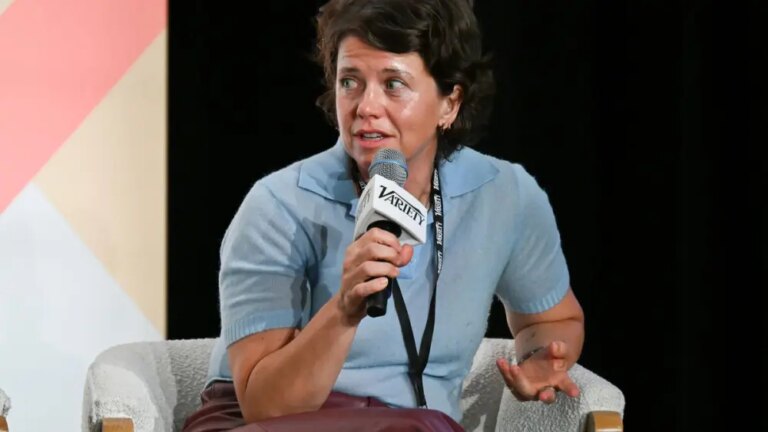
As artificial intelligence becomes increasingly omnipresent in our conversations and industries, entertainment leaders are striving to decode its implications for storytelling and creativity. A recent panel discussion titled “Entertainment and Media in the Age of AI” at Variety’s Entertainment and Tech Summit, moderated by Variety business editor Todd Spangler, gathered notable personalities from the tech and entertainment sectors to explore the multifaceted role of AI. Among the panelists was Mira Line, Google’s vice president of technology and society, who emphasized the need to clarify what “AI” truly signifies in their industry.
Breaking Down AI’s Role in Entertainment
Line remarked, “I think the word ‘AI’ is doing too much right now,” shedding light on the importance of dissecting the concept as it applies specifically to entertainment. In this spirit, the panel featured executives from major companies like Netflix, Lionsgate, Hasbro, Teads, and Adobe, who were united in their quest to navigate the complexities and potential of AI in their respective fields.
Building Trust with Creators
One key area of focus was the development of relationships between AI technology and creators in the entertainment industry. Girish Balakrishnan, Netflix’s senior director of creative innovation, highlighted the streaming giant’s frameworks for utilizing AI within its production processes. Currently implemented in approximately 300 programs, Balakrishnan noted that such transparency “builds trust with the creative community” and enables creators to harness AI meaningfully in their work.
Navigating Intellectual Property Challenges
As discussions evolved, so did the conversation about the proper frameworks pertaining to AI’s role in the industry. Last month, a paper titled “Human Generative Workflows,” spearheaded by Kathleen Kennedy and the American Film Institute with contributions from Line, outlined various use cases that could potentially lead to AI-backed productions being copyrightable. Line explained, “Let’s start thinking about the vocabulary and breaking it down so it’s not just AI as one big monolithic.”
Distinct AI Functions and Industry Guardrails
In her commentary, Meagan Keane from Adobe stressed the importance of distinguishing AI tools by their functions—“assistive,” “corrective,” and “generative.” This classification helps users leverage AI effectively without getting lost in the overwhelming “generative” narrative that dominates current conversations. Furthermore, Annaka Vasquez of Teads noted the delicate nature of incorporating AI-generated content, particularly with recognizable brands, emphasizing that “there’s a lot of scrutiny around that.”
Ensuring Brand Integrity and Intellectual Property Protection
The importance of maintaining brand integrity while employing AI was echoed by Bertie Thomson from Hasbro. He discussed the proprietary guardrails established for AI replicas of licensed characters—like Cobra Commander and Optimus Prime—through their studio, Sixth Wall. “Working on the authorized AI version of the character means that, for these actors, it has a protective value for them too, and also for us as IP owners,” Thomson explained.
Addressing Misconceptions Surrounding AI
Despite advancements, industry leaders continue to grapple with public misconceptions about AI. They aim to clarify that creating high-quality media is a complex endeavor that goes far beyond a simple prompt in a chatbot. “There’s a lot of consideration that goes into everything we make,” Lane asserted, adding that the focus should be on how these technologies can serve the creative process rather than defining their value through pop culture perceptions.
AI as a Tool for Storytelling
By the conclusion of the panel, leaders expressed a shared vision: to leverage AI as a tool to enhance creativity rather than a requirement for survival in a competitive landscape. Balakrishnan claimed, “Filmmakers aren’t asking, ‘Do I want to use AI or not?’ They’re looking to solve meaningful creative problems that they’re faced with on their shows,” pointing to successful Netflix projects that utilized generative AI.
Kathleen Grace from Lionsgate echoed this sentiment, suggesting that AI could facilitate the discovery and distribution of new stories from diverse creators. With tools that democratize access, she is excited about the possibilities: “It’s just more creative people, and in some ways, easier to find them because the tools are democratized.”