Toy Story 5 marks a significant achievement for co-director Kenna Harris, whose journey to Pixar filmmaker began in her childhood. Spent afternoons drawing characters like Jessie from Toy Story 2 and imagining whimsical scenarios featuring Woody, Harris’s admiration for these characters laid the groundwork for her professional aspirations. Years later, she took on the challenge of her first feature alongside director Andrew Stanton, even pausing production for two weeks to refine the film’s narrative.
Finding Inspiration in Creativity and Risk-Taking
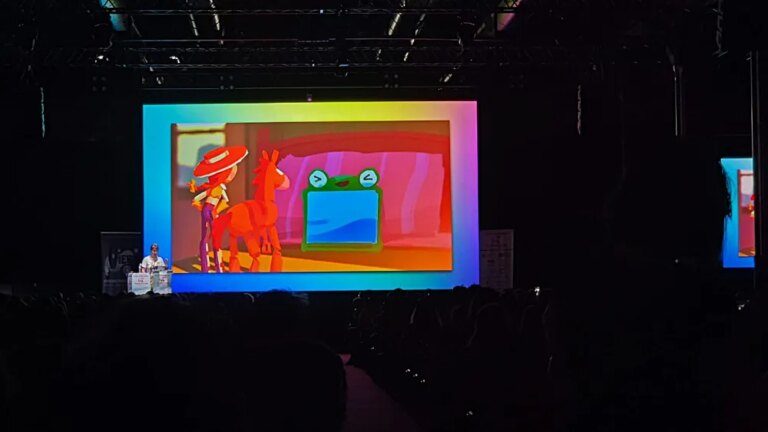
At the View Conference in Turin, Harris expressed the pivotal role Jessie played in her creative process, saying, “She was my cowgirl through and through.” She showcased her childhood fan art as a testament to her deep connection with the character. When approached by Stanton to co-direct in late 2022 after her work on films like Luca and Inside Out 2, Harris eagerly accepted but felt an inclination to co-write the screenplay, despite her inexperience with feature-length scripts. “Who was I to put myself in a position this precarious, where I could very well fail in front of the man who wrote my entire childhood?” she reflected. Ultimately, this bold choice led to a shared screenwriting credit with Stanton.
Innovative Storytelling and Character Development
Harris’s willingness to take creative risks extended to pivotal moments in the film, like her campaign for Jessie and Buzz to share a kiss during a high-stakes action sequence. “I just think there should be a ton of action, and it should be perilous, and then they should kiss super duper hard,” she recounted, and Stanton concurred. Her creative vision also inspired the ranch setting and introduced a new character, Blaze, influenced by images of Jessie riding a real horse. For research, Harris and the story team attended BreyerFest, a Kentucky convention dedicated to model horses.
One of the film’s central challenges involved Lilypad, a tablet that poses a threat to Bonnie’s attachment to her traditional toys. Harris rejected the idea of portraying the device as an unequivocal villain. Instead, she aimed to depict the complexities of balancing technology in children’s lives. However, the early iterations of the story did not resonate emotionally with audiences.
A Two-Week Rewrite that Changed Everything
Harris declared, “We stopped production for two weeks and focused on the film’s core issue at the time.” The first week was spent diagnosing problems; the second focused on rapid rewrites. Initially centered on Jessie’s desire to reclaim playtime with Bonnie after a separation, early screenings revealed that this conflict seemed derivative of the first film’s theme. “The stakes of losing playtime felt too soft,” Harris explained.
The breakthrough came when Bonnie’s loneliness was identified as the emotional heartbeat of the story. Instead of merely seeking playtime, Jessie was tasked with helping Bonnie make a genuine friend. Blaze’s character became instrumental to this new arc, marking a significant shift that Harris noted improved audience reactions during internal screenings.
Emotional Resonance and Character Arcs
An earlier draft proposed a sentimental encounter between Jessie and an elderly Emily; however, Harris felt this resolution was too tidy. The team instead returned to the nostalgic tire-swing tree from Toy Story 2, crafting a more subdued climax revolving around a time capsule. Upon witnessing the revised ending during a screening, Harris declared, “There’s no way we’re changing it.”
The decision to spotlight Jessie as the protagonist was not without its controversies. “Part of the risk of this film was having Jessie as the protagonist,” Harris revealed, noting the doubts about whether audiences would prefer the familiar figures of Woody and Buzz. Nonetheless, the filmmakers remained committed to this direction, recognizing Jessie’s emotional depth as crucial to the sequel’s purpose.
Revamping Visual Style
Harris also played an integral role in shaping the film’s imaginative sequences, advocating for a spontaneous and painterly aesthetic rather than Pixar’s typical realism. “We wanted to lean into something that felt more ephemeral and fleeting,” she shared. This initiative led to experiments in lighting and movement, encapsulated in a collaborative process known as “playtime weeklies.”
A Personal Mark on a Beloved Franchise
The overarching lesson in directing became one of collaboration and delegation — embracing input and leaving room for creativity. Stanton’s guiding theme, “our limited time with others can impact a lifetime,” resonated deeply with both Jessie’s journey and Harris’ own experiences at Pixar.
Reflecting on her time creating a film in a cherished franchise, Harris concluded, “I wanted people to know that I was here.” By the end of the production, that initial apprehension transformed into a sense of confidence: “I look back now, and I can see that I was here.”