U.S. artist and documentarian Lynne Sachs has been a familiar name at the Ji.hlava Documentary Film Festival, having previously screened her films there. However, this year marks her first in-person attendance, where she has taken on the role of a jury member for the First Lights section, devoted to evaluating debut documentaries. Sachs expresses her admiration for the festival’s broad selection of films from around the world, which exemplify a rich tapestry of storytelling styles and viewpoints.
“There are about 24 movies to see. It’s kind of revelatory. Already I’ve seen two films here, one from Argentina and one from Congo, and they really couldn’t be more different. They make you think about the documentary paradigm,” she notes, highlighting the festival’s role in expanding artistic horizons.
Exploring Perspective in Documentaries
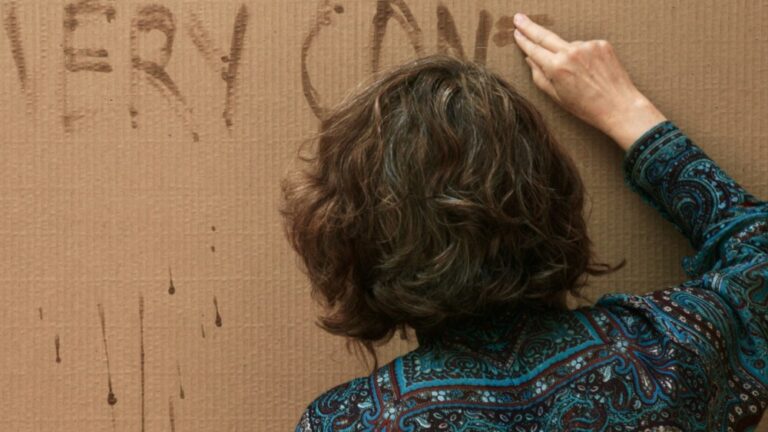
Sachs brings a critical eye to the concept of “positionality” in her work—pondering whose perspective is presented and how visible the filmmaker’s influence is in the storytelling process. This exploration of documentary ethics is particularly evident in her latest film, “Every Contact Leaves a Trace,” which is making its Czech premiere at Ji.hlava.
Through her own lens, Sachs investigates her past by examining old business cards she has collected over the years. With her niece and nephew occasionally lending a hand, she sifts through these remnants, reflecting on the connections she once had and contemplating the meanings that have faded over time.
A Detective Story Unfolds
“Every Contact” takes on a detective-like narrative as Sachs not only follows leads to rediscover individuals connected to these cards but also engages professional forensic investigators to assist in her quest. “I actually hired a detective at one point,” she admits, adding an element of intrigue to her personal narrative.
Some individuals connected to her cards have left profound memories, prompting Sachs to wonder about their current paths. This includes an artist whose work profoundly affected her and another filmmaker who faced serious allegations and was “canceled” in the public eye. One especially poignant card belongs to a Syrian woman who was hesitant to share her refugee experiences on camera. Instead, Sachs opted to create a tribute that celebrated the woman’s culinary talents.
Redefining Documentary Participants
As she navigates these narratives, Sachs expresses discomfort with common terms used to describe people featured in documentaries. Preferring to refer to them as “on camera participants” or “visible collaborators,” she emphasizes the importance of recognizing their agency within their stories. “We’re offered the chance to tell our story by the person behind the camera. What I don’t know is, who is the person behind the camera?” she questions, pointing to the complexities of authorship in documentary filmmaking.
In “Every Contact,” Sachs makes her presence unmistakably clear, often awkwardly reconnecting with individuals she once knew, many of whom might not have expected her return. “I’m trying to reconstruct a life story of experiences from the interactions I’ve had with people… people who left a mark,” she articulates, revealing the deeply personal nature of her project.
The Legacy of Connections
Since the film’s release, Sachs has been approached by others eager to share their own collections of old business cards. “I say, ‘Oh, no!’ This combination of cards only goes back to one person. You’re the person who had that dentist. You’re the person who met that psychoanalyst. Or potential friend on a bus,” she explains, illustrating the unique connections that define her narrative.
As she delves further into her investigative journey, Sachs finds herself drawn to the cards that present the most significant challenges. Some individuals remain elusive, while others may have left lasting impressions without reciprocation. She reflects on the inherent difficulties of recounting these past encounters, acknowledging that memories often become distorted over time.
With the involvement of family in her search, Sachs notes a poignant realization: “It’s not usually even up to us to choose which memories will stay with us and which we’ll lose.” Throughout her exploration of connections and identities, she learns that sometimes the answers lie just around the corner, rather than across vast distances.
“I don’t need to prove I did or didn’t,” concludes Sachs. “I need to deal with the residue.” The lingering traces of her past encounters ultimately shape not only her film but also her understanding of the human experience.