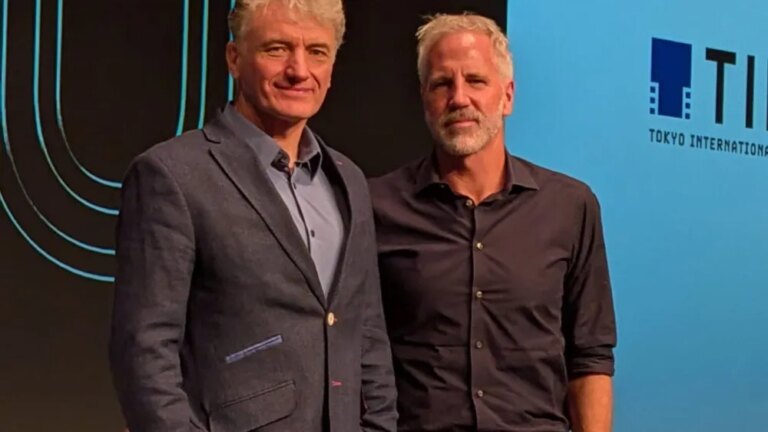
At TIFFCOM, the content market associated with the Tokyo International Film Festival, Chris Brearton and Dominic Hughes of AGBO engaged in a thought-provoking keynote discussion on the intersection of artificial intelligence (AI) and filmmaking. Their insights revealed how AI, far from posing a threat to human creators, can serve as a vital tool in enhancing the storytelling process and shaping the future of visual content creation.
AGBO’s Commitment to Creative Empowerment
Brearton, a partner and business leader at AGBO, along with Hughes, the company’s chief scientific officer and technology leader, emphasized the prime philosophy of AGBO: to place artists at the forefront while leveraging technology to enhance their creative prowess. Headquartered in Los Angeles, AGBO focuses on developing cross-platform entertainment properties, including acclaimed films like “Extraction” (2020), “Everything Everywhere All at Once” (2022), and “The Gray Man” (2022).
Reflecting on the origins of AGBO, Brearton cited the experiences of founders Anthony and Joe Russo during their time on the Emmy-winning series “Arrested Development.” When confronted with a script that was deemed too lengthy and expensive to produce, they embraced digital filmmaking technology to bring their vision to life. “They looked at technology as a solution that empowered them to tell the story they wanted to tell,” Brearton explained, a mindset that remains embedded in AGBO’s corporate culture today.
A Vision for the Future of Entertainment
Brearton also drew inspiration from Walt Disney’s innovative spirit, noting that in 2026, AGBO aims to utilize technology to create a virtual theme park, forging connections within a virtual community. “Creative artists are special,” he asserted, highlighting the unique capability of humans to tell compelling stories. “The way we embrace technology is all about artists and putting artists first.”
Hughes, who has an extensive background in algorithms and machine learning, shared his journey from a young Disney enthusiast to a passionate professional at the crossroads of media and technology. He reinforced the belief that human curation is crucial in creative fields, ensuring that algorithms enhance rather than replace artistic vision. “At AGBO, my role is really about supporting artists to be more and more creative,” Hughes said.
AI as a Supportive Tool
While excitement surrounds the potential of AI in creative processes, both Brearton and Hughes acknowledged public anxieties regarding an AI-dominated future. Brearton dismissed misconceptions about AI’s ability to replace humans, asserting that “what makes a favorite performance by a favorite actor special is the human element.” He argued that AI’s true impact lies in streamlining processes and addressing hindrances in the creative workflow, effectively empowering artists.
Hughes further elaborated that while AI can crunch data and suggest solutions, the irreplaceable qualities of top-tier artists remain outside its reach. “Machines don’t have the creativity required for that degree of novelty,” he stated, noting that AI excels at recycling existing ideas rather than generating original content. He also pointed out that AI can assist in understanding whether a play might have been written by a significant playwright, but it would fall short in attempting to compose a new work of similar caliber.
The Dual Nature of AI in Creativity
Brearton emphasized AI’s potential to democratize storytelling, enabling new filmmakers to create projects they may not have been able to afford otherwise. “We’ll see new filmmakers making movies that otherwise you wouldn’t have seen,” he noted, suggesting that AI can facilitate creative visions on limited budgets. However, Hughes warns against the risk of AI generating excessive amounts of mediocre content, ultimately urging for a commitment to enhancing quality in storytelling.
Concerns regarding copyright and content appropriation also surfaced during the discussion. Brearton reassured attendees that AGBO diligently tracks the use of all tools and ensures a comprehensive approach to copyright management, highlighting the importance of intention in content creation.
The Future of Consumption and Creation
Brearton concluded by elaborating on the concept of “concurrence” in entertainment consumption, noting that younger generations engage with multiple media sources simultaneously. He argued that creators must possess the ability to weave stories across varied platforms while providing consumers with authentic entertainment experiences. “Underlying all that, you still have to create incredible stories with wonderful characters in a rich world to live in,” he affirmed.
Moderated by Naman Ramachandran, Asia Editor of Variety, the keynote highlighted the collaborative path forward in the entertainment industry, where AI serves as a tool for enhancement while celebrating the irreplaceable artistry of human creativity.