In the lead-up to Kamala Harris’ presidential campaign two years ago, I embarked on an enlightening journey through Alabama and Georgia aboard a large blue bus adorned with the words “Faith, Hope, & Love.” This initiative, organized by a group called Vote Common Good, aimed to encourage voters to support candidates who they believed would champion the common good—predominantly Democrats. A central objective was to challenge the perception that the Republican Party had an exclusive claim to godliness, promoting the idea that voting for Republicans was synonymous with voting for God.
The bus crew consisted of disillusioned evangelicals, free-spirited musicians, outcasts from megachurches, and activists advocating for racial justice. Collectively, they believed that the teachings of Jesus—emphasizing the importance of feeding the hungry, clothing the poor, and loving one’s neighbor—aligned more closely with Democratic ideologies than Republican ones. As a progressive Christian, I wholeheartedly supported their mission, yet I viewed it as a venture limited to the fringes of political discourse. Doug Pagitt, the group’s executive director and a pastor from Minnesota, shared this sentiment. He likened their efforts to a “40-year project,” acknowledging that while even a slight shift in evangelical voting patterns could influence key districts, they faced a long uphill battle against an entrenched Christian Right.
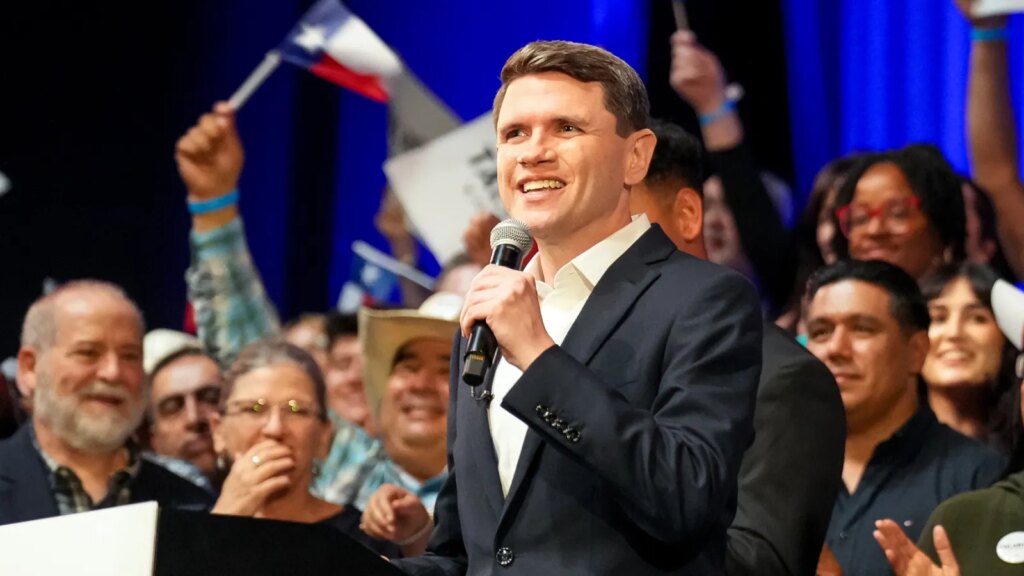
The recent election results, however, revealed a remarkable shift. James Talarico in Texas and Adam Hamilton in Kansas achieved significant victories in their deep-red states, winning their Senate elections by margins of 12 and 5 points respectively. This success was not only a response to a reckoning the Republican Party desperately needed, but also a testament to their appealing candidacies against lackluster opponents and the resonance of their faith-based messaging, particularly in areas with large church-going populations.
Editor’s picks
Hamilton and Talarico not only validated a Christian voter base seeking a reason to support Democratic candidates but framed their political engagement as a natural extension of their faith. Hamilton, the lead pastor of the largest United Methodist church in the country, often referenced biblical principles around justice, fairness, and equality during his campaign. He questioned, “What Gospels are you reading?” in response to those who claimed to be Christians yet failed to align with these values. Talarico, a Presbyterian seminarian, made bold statements supporting gun control, LGBTQ rights, and abortion access—not in spite of biblical teachings, but because of their foundations in scripture. He countered authoritarianism and Christian nationalism by arguing that the moral teachings found in the Bible overwhelmingly emphasize economic justice and the care for marginalized groups, stating, “Christians have a moral obligation to speak out against this perversion of our faith.”
These types of arguments, historically voiced by the Christian left, had often been overlooked during political primaries, remaining on the margins of national discourse. Interestingly, former President Trump’s turbulent tenure catalyzed this shift, creating opportunities for the religious left to gain traction. The corruption, incompetence, and authoritarian leanings displayed during his administration inadvertently opened doors that might have otherwise remained closed for decades.
Related Content
To capitalize on this newfound momentum, the Democratic Party must embrace a strategy that transcends mere opposition to Trump. A vision centered on broad unity and a coalition that welcomes diverse perspectives is essential. Pagitt stresses, “Democrats can expand the democracy-supporting coalition by including people of faith.” This inclusion does not necessitate a more religious party or an emphasis on running explicitly religious candidates; rather, it calls for genuine outreach to the myriad communities representing the diverse fabric of society.
Trending Stories
This does not entail superficially sharing Bible verses or emulating the religious right’s narrative. Instead, it involves promoting candidates whose values resonate deeply and extend beyond party allegiance. While these values need not originate from religious beliefs, the recent election results suggest that authentic faith—which does not seek to legislate beliefs but highlights moral grounding—can enhance a candidate’s appeal among the electorate. A Pew Research Center poll indicates that although many Americans endorse the separation of church and state, there remains a widespread belief in the positive influence of religion within society.
America has a notable legacy of progressive Christians leveraging their faith for social betterment, evidenced by their role in the Underground Railroad and their ongoing struggle against poverty, child labor, and war. This tradition embodies a social gospel that prioritizes the tangible healing of the world over a strict, fundamentalist interpretation of faith. Talarico and Hamilton, emerging from this rich history, represent a refreshing vision of faith that resonates with many Americans—a testament that could herald a new chapter embraced by voters eager for change and meaningful action.