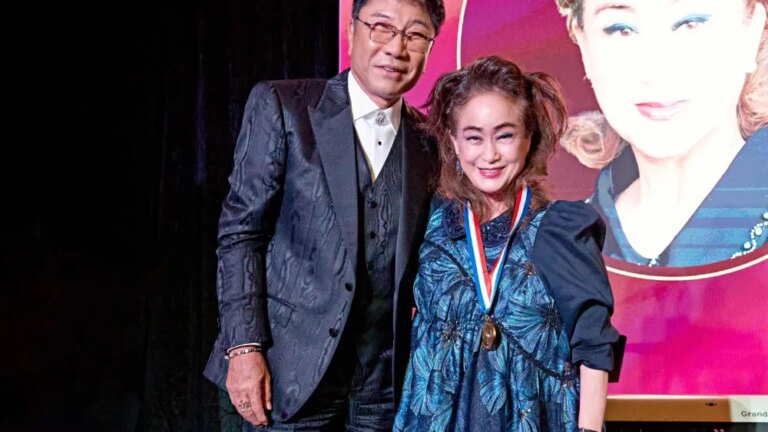
Miky Lee, vice chair of Korea’s CJ Group, was recently honored with the Asian Hall of Fame’s Centennial Medal of Lifetime Achievement in Los Angeles. The prestigious award was presented by Lee Soo-man, founder of SM Entertainment and a celebrated figure in the K-pop industry, who referred to Miky as the “godmother of K-culture.”
A Legacy of Cultural Impact
The Asian Hall of Fame bestows its medal on individuals demonstrating exemplary character, influencing their industries, and bridging cultural divides. Miky Lee was recognized for over three decades of efforts connecting South Korea with global audiences through film, music, and television.
Longstanding Friendship and Collaboration
Lee Soo-man and Miky Lee share a friendship that spans more than 50 years. They first crossed paths when Soo-man was a college student and an accomplished singer, while Lee was still in middle school. “Even then, she was already the boss,” he reminisced. He recounted a recent incident in Dubai when Miky Lee flew in unexpectedly to see him, noting, “I’ve learned over the years that it’s very difficult to say no to Miky Lee.”
Transforming the Entertainment Landscape
Reflecting on the year 1995, a time when CJ Group was primarily recognized as a food company, Lee Soo-man highlighted Miky Lee’s visionary role in transforming Korea’s entertainment sector. He credited her with guiding CJ’s investment in DreamWorks, revolutionizing Korea’s film industry through the establishment of CGV, and playing a vital role in elevating the MAMA Awards and KCON into internationally recognized platforms.
Cultural Vision and Influence
In her acceptance speech, Miky Lee emphasized the essential role of culture, stating, “Culture is like oxygen. We may take it for granted, but we cannot live without it.” Raised in Seoul after being born in Knoxville, Tennessee, she recalled her grandfather’s belief: “No culture, no country!” She and her brother Jay adopted this philosophy as they expanded their business from food into engaging with the visual and auditory senses of audiences.
She described the DreamWorks partnership as a learning opportunity rather than a pursuit of Hollywood fame. This journey continued with the launch of CGV—the first multiplex in Korea—in 1998, followed by significant ventures into cable television and the production house Studio Dragon.
Shaping a New Musical Landscape
Miky Lee presented Mnet as a platform for the new generation to explore local music, noting that during her early years, about 85% of the songs featured on Korean television were American pop. By the 2000s, this trend began to reverse. The global expansion of the MAMA Awards and KCON connected fans across cities such as Bangkok, Hong Kong, Los Angeles, and Tokyo, realizing her dream that “Music Makes One.”
A Commitment to Future Creatives
Throughout her career, Miky Lee has collaborated with notable Korean filmmakers, including Park Chan-wook, Bong Joon-ho, and Hwang Dong-hyuk, among others, illustrating that stories rooted in Asian cultures can resonate worldwide. “Our greatest legacy is not simply what we have accomplished, but the opportunities we create for those who come after us,” she remarked during her speech.
Miky Lee served as an executive producer on Bong Joon-ho’s “Parasite,” which made history as the first non-English language film to win the Academy Award for Best Picture, among its four Oscar victories. In addition, KCON, which started in the U.S. in 2012, has evolved from a K-pop festival to a convention that also encompasses Korean food, beauty, and lifestyle trends. The MAMA Awards began in 1999 and have continued to celebrate artistic excellence in music. Recently, CJ ENM established the First Light StoryHouse label to support Asian creators through direct investment and co-production from early project development.
Honoring Contemporary Achievements
The Asian Hall of Fame recognizes Asian and Indigenous contributions and celebrated its 22nd induction ceremony this year, also honoring K-pop sensation Rosé from Blackpink and celebrated Japanese baseball player Nomo Hideo. Guests at the ceremony included prominent figures such as Korean hip-hop artists Tiger JK and Yoon Mi-rae, X Japan leader Yoshiki, and others from the entertainment and cultural sectors, reflecting the broad impact of individuals like Miky Lee in shaping the future of K-culture.