Mahmoud Khalil, a prominent pro-Palestine activist, has vowed to continue his advocacy for Palestinian human rights following his recent release from an Immigration and Customs Enforcement (ICE) detention facility. Khalil’s detention, which lasted over three months, was brought to an end by a judge’s order, allowing him to post bail. His case has drawn significant attention, given the allegations that led to his arrest and the impact on his personal life. Khalil’s commitment to protest remains steadfast as he navigates the legal and political challenges surrounding his situation.
Activist’s Release and Resolve
After being detained for over three months, Mahmoud Khalil was released on bail from an ICE facility. The Columbia University activist, who missed both the birth of his child and his graduation, expressed his determination to continue protesting for Palestinian human rights. Khalil’s arrest in March was prompted by the Trump administration’s move to revoke his permanent residency, arguing his presence posed “serious adverse foreign policy consequences.” He faced detention due to alleged omissions on his green card application, claims strongly contested by Khalil and his supporters.
Voices of Support and Protest
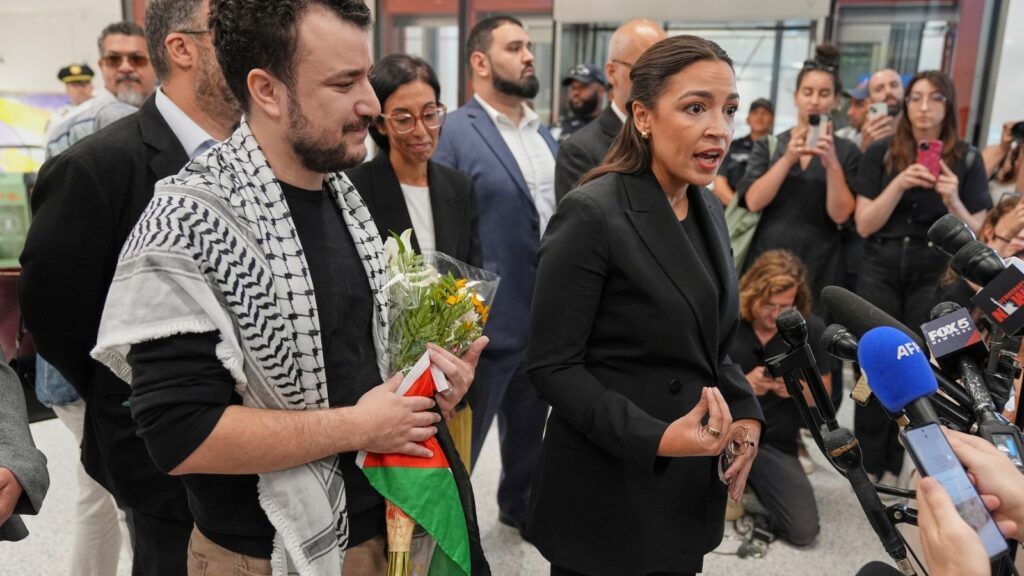
At a press conference, Khalil highlighted his intention to keep protesting U.S. support for Israel’s actions in Gaza and called for Columbia University to divest from companies profiting off the conflict. “This is why I was protesting,” Khalil asserted, “This is why I would continue to protest with every one of you, [even] if they threatened me with detention, even if they would kill me, I’m still speaking for Palestine.” Despite his confinement in an ICE detention center in Louisiana, Khalil insisted he felt free and emphasized the humanity of his fellow detainees, who he described as “incredible” despite being portrayed as criminals by the administration.
Political and Legal Repercussions
Rep. Alexandria Ocasio-Cortez stood alongside Khalil, condemning his detention as a violation of his First Amendment rights. “Mahmoud Khalil was in prison for 104 days by … the Trump administration, with no grounds and for political reasons,” she stated. Ocasio-Cortez and other supporters argue that Khalil’s arrest was politically motivated due to his advocacy for Palestinian human rights. Baher Azmy, legal director of the Center for Constitutional Rights, labeled Khalil’s treatment as “outrageous” and “unconstitutional,” emphasizing that his release is only a partial victory given the prolonged struggle.
Judicial and Public Reactions
The decision to release Khalil on bail was made by New Jersey District Judge Michael E. Farbiarz, who suggested there might be an effort to use immigration charges to punish Khalil for his speech on Palestine. “And, of course, that would be unconstitutional,” Farbiarz remarked. Conversely, Tricia McLaughlin from the Department of Homeland Security criticized the ruling as undermining national security. Despite differing opinions, Khalil’s wife, Noor Abdalla, expressed relief at his release, celebrating his return to New York and their reunion. She highlighted the ongoing struggle against efforts to silence dissent regarding Palestinian freedom.