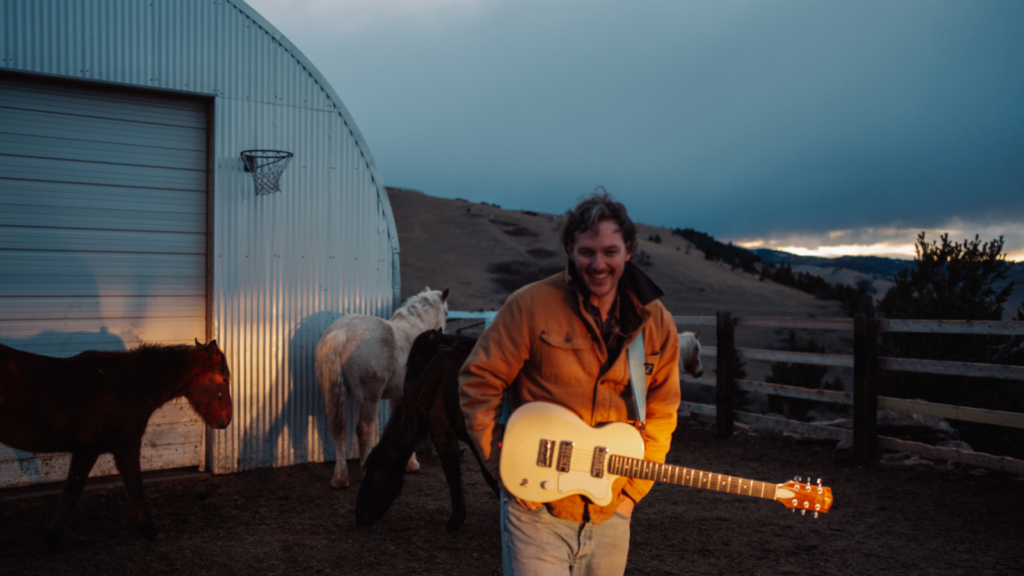
As summer wanes, Houndmouth’s lead singer and guitarist, Matt Myers, strolls along Main Street in Burlington, Vermont, preparing for his performance that evening as the opening act for The Head and the Heart. He pauses at a corner, beads of sweat forming on his neck, to reflect on personal growth and the power of love. The music tour has taken him far, but the warmth of familiarity remains as he meets with family nearby for a brief catch-up.
“Falling in love changed everything,” Myers says, sharing candidly with Rolling Stone. “To finally be accepted, no matter what, by my wife and my friends… because I’ve always shown the same thing to people, and to get that reciprocated, that fucking rocks.” At 38, Myers has found solace and balance in his life through his second marriage, which he entered two years ago, and raising his two daughters from his first marriage. This newfound harmony permeates the lyrical themes of Lordy, Houndmouth’s latest album, released under Dualtone Records as a highlight of the label’s 25th anniversary.
Embracing Change and Authenticity
For Myers, the album encapsulates a journey of self-recognition and acceptance. He conveys a sense of comfort with aging, proudly acknowledging the salt-and-pepper in his hair and the wrinkles earned from extensive touring. “It’s a long way from my baby-faced nature when I formed Houndmouth in 2011,” he reflects. He understands that great songs don’t require sadness to inspire creativity. “You don’t have to be sad to create,” he states. “I’m happy at home. Now when I’m writing, the song doesn’t have to be grandiose. You don’t have to overthink—just write, edit, and let the song be what it is.”
Still rooted in New Albany, Indiana—the birthplace of Houndmouth—Myers draws inspiration from the geographical and musical blend of the Midwest and the South, a region known for producing influential rock acts. In his earlier days, he played locally, performing covers at venues like Huber’s Winery, which often led to frustration when trying to introduce original material. “You play for four hours and your fingers are just toasted. And then you try and throw an original song in, and it never works,” he recalls. “Eventually, I decided, ‘I’m going to get my friends together. We’re only playing songs we write and we’re not making any compromises.’”
From Local Gigs to National Recognition
The band’s name, generated via an online name generator, heralded the beginning of their rise. After catching attention at South by Southwest, they signed with Rough Trade Records, marking the start of a whirlwind career that saw them perform at iconic festivals such as Lollapalooza and Bonnaroo. Their 2015 album Little Neon Limelight propelled them onto the national stage with catchy hits like “Sedona” and “Darlin’.” Myers muses on their journey, stating, “It really was just bearing our head and believing. It’s not the path I thought it would be. At first, you’re like, ‘Oh yes, the rocket ship,’ but it just doesn’t work out like that, and I feel like I wouldn’t be grounded much at all.”
Myers’ storytelling ability shines through later songs like “McKenzie” and “Miracle Mile” from their 2021 album Good for You, which showcase his blend of shoegaze indie-rock infused with alt-country and blues influences. “I naturally tell stories and don’t embellish stuff, where it’s more personal,” he explains. “I didn’t have the drive to make up elaborate, lavish stories.”
Reflecting on Growth and Intent
As the only remaining founding member of Houndmouth, with keyboardist Caleb Hickman joining the ranks in 2016, Myers acknowledges the evolution of the band’s sound. The blues influences remain a tether to their roots, as exemplified in tracks like “Sedona,” where he sings, “Well hey little Hollywood/You’re gone but you’re not forgot/You got the cash but your credit’s no good/You flipped the script, you shot the plot,” reflecting the band’s current standing.
“This has been a full-circle moment for me,” Myers concludes as he stands in front of Burlington’s City Hall Park, contemplating how he has matured from a carefree 24-year-old to a grounded 38-year-old with a clearer perspective on life and music. “It seems more intentional this time,” he adds, illustrating a deeper understanding of creativity rooted in both happiness and experience.