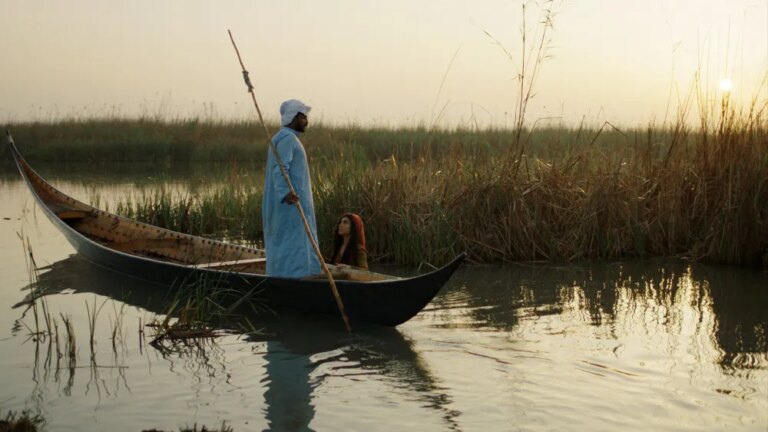
Iraqi-Swiss filmmaker Ali Toffan Al-Fatlawi’s debut feature “The Blind Ferryman” takes shape from a poignant realization borne out of the violence of Iraq’s civil war in 2006. While watching the devastating impact from his home in Switzerland, Al-Fatlawi found himself reflecting on the lives of his blind aunts, contemplating whether their blindness might provide an escape from the turmoil surrounding him. This thought became the cinematic foundation of a film that delves into the essence of perception, belief, and trust.
The Journey of Creation
The narrative follows Ayoub, a blind boatman played by Ahmed Moneka, who develops a profound love for Genya, a mysterious woman that others cannot see. Defined by his convictions, Ayoub faces ridicule from his community, forcing him to stand firm for a love that exists solely in his heart. “When you love someone, why do you need the agreement of other people?” Al-Fatlawi poses, emphasizing the personal nature of affection.
Influenced by tales of a mythical woman from his father and the rich tapestry of Sumerian mythology, the character of Genya embodies the filmmaker’s intrigue with the powerful presence of female deities in ancient Mesopotamian lore. This exploration invites a thoughtful critique of how such figures have been overshadowed by a male-oriented perspective in contemporary religion.
A Different Perspective on Iraq
Set against the lush backdrop of Iraq’s southern marshlands, Al-Fatlawi’s film seeks to portray an alternative side of a country often depicted through the lenses of war and devastation. “I don’t want to do a movie which shows that we are poor people, asking for sympathy,” he asserts, striving instead to convey a narrative that challenges Western perceptions of suffering and victimhood.
In a conscious effort to disrupt stereotypes, Ayoub is portrayed as a Black Iraqi, while a white, blue-eyed outsider serves as the looming threat. This deliberate casting choice interrogates societal assumptions about who represents heroism and villainy.
A Commitment to Authenticity
Driven by a desire to question the line between reality and appearance, Al-Fatlawi’s directorial choices resonate through the film’s visual language. As a painter and performance artist transitioned into filmmaking, he infused his screenplay with artistic elements, often sketching scenes prior to writing them. “I paint and then I write, I paint and then I write. That’s my way to write,” he explains.
Working alongside his cinematographer, Al-Fatlawi opted for a 4:3 aspect ratio, enabling a closer relationship among the characters, while also balancing wide shots that equally represent the marshland and its reflection in the water. “I told him, I want really in the middle, 50%,” he reflects, emphasizing the film’s intricate composition.
This meticulous attention to detail extended to his direction of the actors as well. He instructed Moneka to keep his eyes open throughout the film, resisting any notion of blindness that might conjure pity. “I don’t want people to feel sorry for you,” he says, encouraging strength in vulnerability through Ayoub’s character.
For actress Sam Rahmani, who portrays Genya, the challenge lay in balancing the duality of her character as both real and mythical. “I had to portray the whole spectrum without losing credibility as either,” she notes, crediting Al-Fatlawi for creating a world that held space for that complexity.
A Personal Return
Rahmani’s journey in “The Blind Ferryman” also represents a personal homecoming, as she reconnected with her Iraqi heritage while filming on location. Engaging in everyday life in Iraq allowed her to embrace her dialect authentically after years of navigating different cultural landscapes. “It was such a surreal and, I don’t know, special feeling full of relief,” she shares, celebrating the gift of self-acceptance the project helped her reclaim.
Production Challenges
The film’s development began in 2015, securing backing from various film festivals and institutions, including around $2.5 million in funding. Yet, following a 45-day shoot in Iraq, Al-Fatlawi faced the challenge of completing a crucial underwater sequence. Opting for a cenote in Mexico to capture his envisioned scene, he collaborated with inexperienced underwater photographers and completed the sequence at a fraction of the expected cost—$15,000 instead of $100,000 to $150,000.
A Meaningful Impact
At the Cairo International Film Festival, Al-Fatlawi expressed a deep sense of fulfillment witnessing audiences uncover meanings within “The Blind Ferryman” that he hadn’t explicitly intended. “They add things which make the movie even richer,” he reflects, appreciating the diverse interpretations that allow viewers to engage with the narrative from various perspectives.