The complexities of filmmaking are palpable, especially in the ambitious world of blockbusters. This was the key takeaway from the recent premiere of “Behind the Scenes of ‘The Odyssey,'” a 75-minute documentary that provides an in-depth look at the making of Christopher Nolan‘s $1.8 billion box office hit. The documentary debuted on Tuesday at the Spielberg Theater, located on the Universal Studios lot.
Nolan humorously acknowledged his knack for “talking a lot and revealing absolutely nothing,” before encouraging everyone to enjoy the film. However, the full version of the documentary will not be available to the general public; this 75-minute screening was a one-time event. A shortened version will be released digitally on November 17, although Universal has yet to confirm which segments will be included.
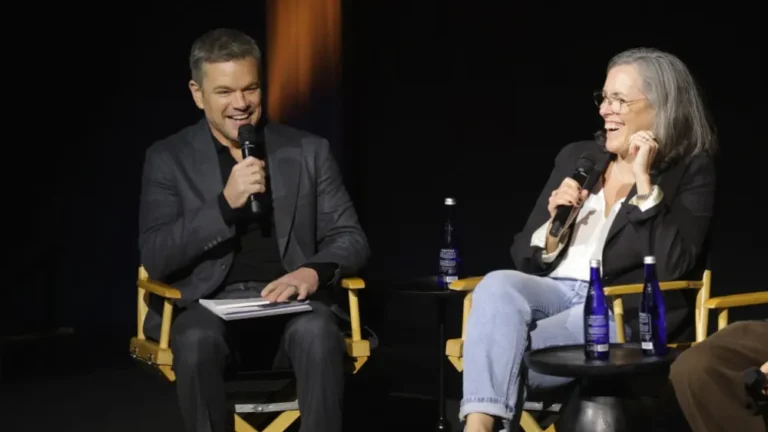
Following the screening, star Matt Damon, who portrays Odysseus, engaged in a lively hour-long discussion with 12 key department heads, including producer Emma Thomas, production designer Ruth De Jong, editor Jennifer Lame, and composer Ludwig Göransson, among others. The packed audience included guild voters and social media influencers, such as comedian Evan M. Williams. After the event, attendees mingled in the lobby, enjoying exhibits that showcased the film’s artistic achievements alongside conversations and selfies.
This premiere marks the beginning of Universal’s two-week awards season campaign for “The Odyssey,” which is poised to be Nolan’s most successful project to date. The studio is aiming to secure nominations in all pertinent categories, hoping to surpass the record of 16 Oscar nominations achieved by Ryan Coogler’s “Sinners” earlier this year.
The zeal for promotion continues with imminent screenings, such as one moderated by Robert Downey Jr. on Wednesday at the TCL Chinese Theatre, followed by another with Guillermo del Toro at AMC Universal CityWalk on Thursday. On November 17, Steven Spielberg will engage in conversation with Nolan at the DGA Theater, coinciding with the digital release of “The Odyssey.”
Nolan is also giving back to the filmmaking community, as he plans to moderate a Q&A session with “Digger” director Alejandro G. Iñárritu on Saturday.
Revelations from the Documentary
Matt Damon didn’t loop a single line on “The Odyssey.”
Damon shared a remarkable fact during the post-screening Q&A: he did not re-record any of his lines throughout the production of “The Odyssey,” which he described as exceedingly rare for a film of this scale. He turned to production sound mixer Willie Burton, who confirmed the strict rules set by Nolan, stating that “there’s no ADR with Chris” and emphasizing the meticulous approach to on-set sound capture.
The commitment to authentic sound design was so strict that Burton recalled times he was sent below deck during production, where he ran cables and mounted microphones while enduring water pouring down on him—an experience that also made him the ship’s unofficial snack clerk.
The documentary further illustrates the dedication behind the film’s sound design, revealing that Henighan dispatched a crew to capture the authentic sounds of the ship, including every oar stroke. The re-recording mixers noted that almost every sound element used in the film is organic, bringing the viewers closer to the raw realities of the world depicted.
The Cyclops started as a desk lamp test.
Nolan sought to deviate from the “very cartoony, very unthreatening” portrayals of the Cyclops in earlier adaptations. Instead, his vision was inspired by Francisco Goya’s painting “Saturn Devouring His Son” for its haunting and indifferent expression. De Jong proposed a new design, and visual effects supervisor Andrew Jackson conducted a test with actor Bill Irwin, who portrayed Polyphemus. Using a desk lamp to illuminate Irwin, Jackson digitally altered his appearance by shifting one eye to the center of his face, which proved to be an effective design concept.
Initially, the giant creature was to be represented by a basic stick-figure puppet. However, after scouting locations in Greece, the team was inspired to create a full-scale puppet and complete the creature in just two months for shooting in a Greek cave. The result was a simpler design that ended up bringing the character to life in a more impactful way than originally planned.
Tom Holland asked for a shorter skirt to look taller, and Robert Pattinson wanted a long wig. Both were rejected by Nolan.
Notably, the documentary highlights the practical challenges and humorous anecdotes associated with casting and costume design. Tom Holland, who plays Telemachus, revealed he requested a skirt alteration for height reasons, but once presented to Nolan, it was swiftly rejected. Meanwhile, Robert Pattinson, cast as Antinous, sought a long wig but was denied the same courtesy.
Emma Thomas, Nolan’s producing partner and wife, shared how Nolan’s meticulous standards can be daunting during the preparation stage, yet he often adopts a pragmatic approach once filming commences. This is evidenced by the rigorous rules imposed on hair and makeup departments. Nearly 7,000 extras went through fittings in Morocco, with 80 artists working to erase any contemporary signs such as tattoos.
The design choices served a narrative purpose, with Penelope’s wardrobe symbolic of hope and anticipation for Odysseus’s return, as elaborated by Anne Hathaway onstage. The casting of characters was equally crucial to the film’s authenticity, with the casting director emphasizing that the actors needed to match the rugged reality of ancient Greece.
When asked about the physical demands of his role, Damon, who is now 54, shared candidly about the intense physicality required for portraying Odysseus, stating with a hint of humor, “I’m 54 years old, and I knew this was going to be really physical.”
Filmmaking Challenges
Nolan told his Marine Coordinator, “I Don’t Accept That” about physics.
During filming for the Laestrygonian sequence in Scotland, a significant challenge arose when a heavy storm destroyed one of the production’s boats. Marine coordinator Neil Andrea informed the team that restoring the vessel for shooting the next day was “literally impossible.” Nolan countered the grim prognosis, responding with determination, “I don’t accept that.” Remarkably, the boat was seaworthy again by the following morning.
Nolan’s intent to minimize on-boat production was challenged by the realities of filming “The Odyssey,” as he acknowledged that such adventures are intrinsic to the story. Marine team’s creative ingenuity was evident as they transformed Viking ship replicas into Greek warships for the film, even adapting the structures to accommodate engines for the storm scenes shot on the Universal backlot.
The Trojan Horse got stuck in customs.
Logistics posed further challenges, particularly with the iconic Trojan horse. Nolan had to expedite the filming schedule in Morocco as the massive prop remained stuck in customs, creating an unexpected setback. Once it was finally on-site, the rising tide tipped the horse over, yet Nolan’s unwavering attitude prevailed: “Great. Well, I’m gonna shoot this tomorrow.”
The fall of Troy was depicted through a detailed practical set, constructed over 2.5 acres in a matter of a few months. Cinematographer Hoyte van Hoytema aimed for a firelit visual style, devising special LED fixtures known as “pyrahedrons” to replicate natural firelight.
Nolan’s Vision
Nolan sees his entire filmography inside Homer.
The documentary’s opening delivers a masterclass of sorts from Nolan himself, who expressed to Damon that his vision for the film simply began with the words, “The Odyssey.” To Nolan, the essence of Homer’s epic is deeply intertwined with the core of his own storytelling, often finding parallels to his past works, such as “Interstellar” and “The Dark Knight.”
Instead of emulating the artistic conventions established by earlier cinematic interpretations, Nolan’s film embraces a grounded aesthetic similar to his prior successes, applying it to the realm of ancient Greek mythology.
Ludwig Göransson built the score around 35 bronze gongs.
The documentary also explores the intricacies behind the film’s musical score led by composer Ludwig Göransson, who hinted that the score primarily revolved around bronze gongs. Denoting creativity, he spent ten days during the Los Angeles fires refining his craft around these instruments, even seeking out musicians skilled in antiquated melodies.
Recording sessions took Göransson around the world, culminating in an emotional collaboration during the completion of the end-credits song “When I’m Home,” incorporating original vocal tracks from Travis Scott, who plays the bard in the film.
The insights provided in the documentary not only illuminate the tireless effort channeled into “The Odyssey” but also reinforce the film’s commitment to authenticity and artistry. As Damon expressed onstage, “My whole life was kind of leading up to this movie, and I don’t know how long we’re going to get to make movies this way.”
As the evening concluded, Emma Thomas emphasized the collaborative spirit of the cast and crew, noting that the film’s success could not have been achieved without Damon’s accessibility and enthusiasm throughout production. The sentiment echoed in Damon’s own reflections, remarking on the unprecedented challenges faced by the team. The evening served as a testament to both the film and the remarkable community that brought Nolan’s vision to life.